

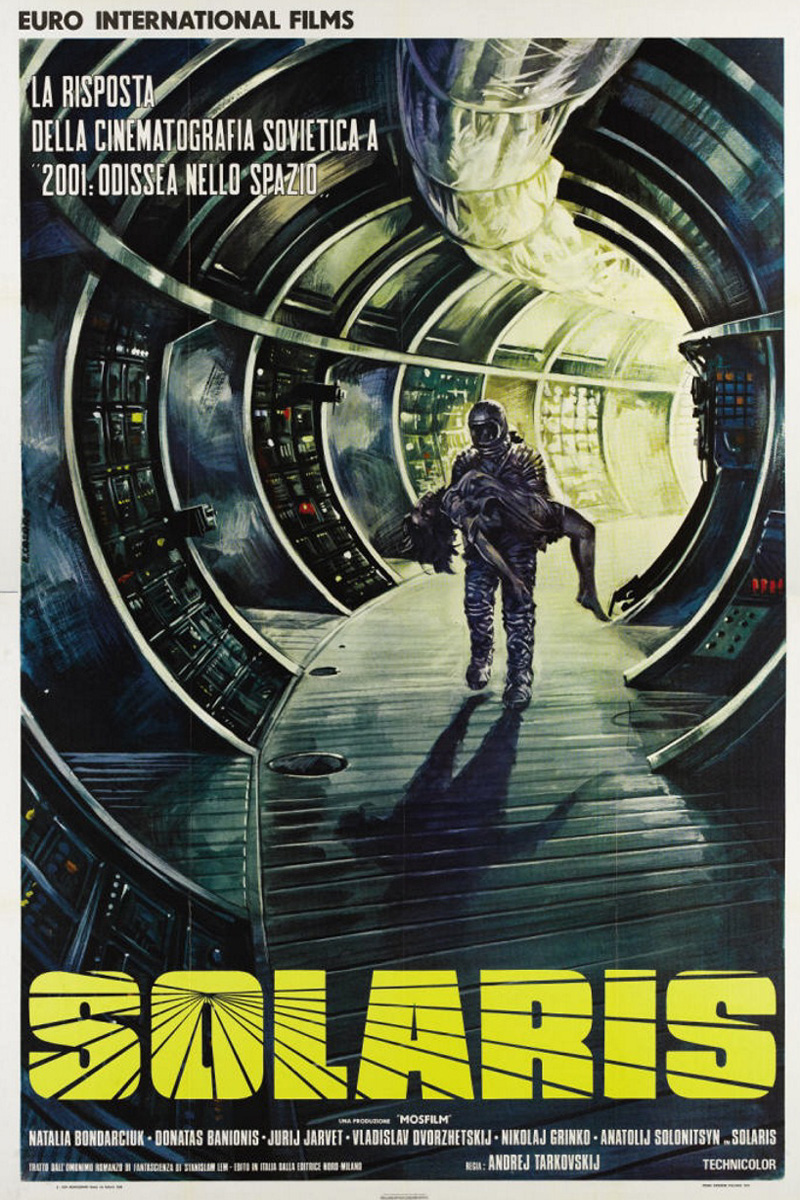
Often called the Soviet answer to 2001: A Space Odyssey, Tarkovsky’s Solaris is a psychological sci-fi epic that focuses on the inner space of the human heart rather than the outer space of technology. Psychologist Kris Kelvin is sent to a space station orbiting the sentient ocean-planet Solaris to investigate why the crew has fallen into madness. Upon arrival, he is confronted by a “guest”: a physical manifestation of his late wife, Hari, who committed suicide years prior.
The film is a slow-burn meditation on grief, memory, and the limitations of human understanding. Tarkovsky fills the space station with reminders of Earth—old books, paintings, and plants—to contrast the sterile environment with the richness of the human spirit. The planet Solaris acts as a giant mirror, reflecting the scientists’ deepest shames and desires back at them. It is a haunting exploration of whether we can ever truly know another person, or if we only love our memories of them.
Natalya Bondarchuk gives a stunning, tragic performance as the “copy” of Hari, who slowly gains self-awareness and struggles with the fact that she is not “real.” The film’s long, hypnotic sequences—such as the famous drive through a futuristic Tokyo—are designed to shift the viewer’s perception of time. Solaris is a profound, deeply emotional work that suggests that even among the stars, we are always haunted by the things we left behind on Earth.
Sources & Bibliography
- Web: mosfilm.ru