

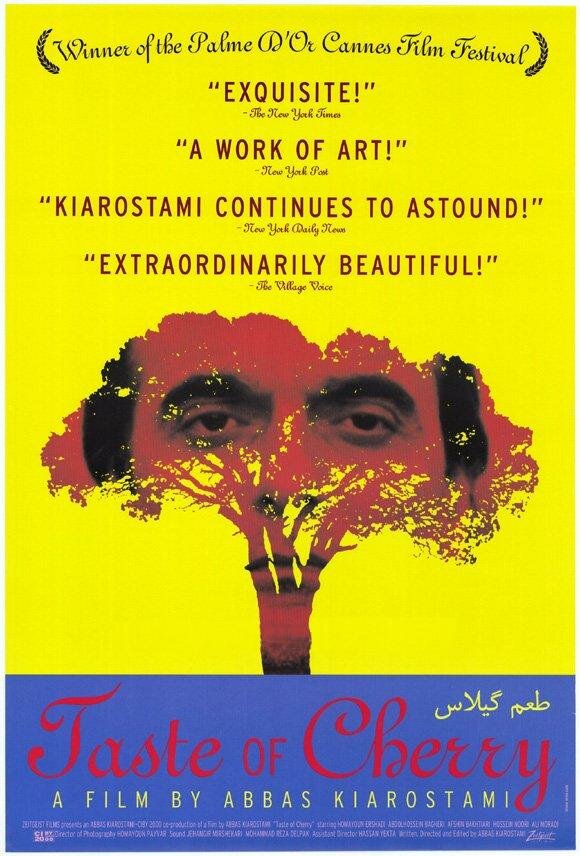
Abbas Kiarostami’s “Taste of Cherry” (Ta’m-e gīlās), winner of the 1997 Palme d’Or, remains one of the most profound meditations on existence ever committed to film. Eschewing the traditional dramatic arcs of Western cinema, Kiarostami presents a narrative of deceptive simplicity: a middle-aged man, Mr. Badii, drives his SUV through the dusty, undulating hills of suburban Tehran. He is searching for someone to perform a specific task—to cover his body with earth in a freshly dug grave after he commits suicide, or to pull him out if he has failed.
The film’s power lies in its minimalist rigor and its refusal to provide a backstory. We are never told why Badii wishes to end his life; instead, we are forced to sit with him in the claustrophobic intimacy of his vehicle. As he picks up a succession of passengers—a shy Kurdish soldier, an Afghan seminarian, and an elderly Turkish taxidermist—the car becomes a confessional. Each passenger offers a different perspective on life, duty, and divine law, turning the physical journey into a philosophical inquiry into the “right” to die versus the “obligation” to live.
Visually, Kiarostami uses the stark, monochromatic landscapes of the Iranian countryside to mirror Badii’s internal desolation. The repetitive circling of the hills and the rhythmic crunch of gravel under tires create a hypnotic, almost liturgical atmosphere. This aesthetic choice emphasizes the cyclical nature of life and the earth. The camera rarely leaves the car during the dialogues, focusing on the subtle shifts in Badii’s expression, played with extraordinary restraint by Homayoun Ershadi, whose weary eyes suggest a soul already halfway to the soil.
The final passenger, the taxidermist Mr. Bagheri, provides the film’s moral pivot. He does not offer a grand theological argument but speaks of the sensory pleasures that make life worth enduring: the taste of a cherry, the sight of a sunrise, the smell of rain. It is through this small, tangible appreciation of the world that Kiarostami subtly challenges Badii’s nihilism. The director suggests that while the “why” of suffering may be unanswerable, the “how” of living is found in the microscopic beauties of our environment.
“Taste of Cherry” concludes with a famously polarizing meta-fictional coda that breaks the fourth wall, reminding the audience of the film’s own construction. This gesture does not diminish the emotional weight of Badii’s struggle; rather, it elevates the film into a universal allegory. It is a masterpiece of “slow cinema” that demands patience but rewards the viewer with a lingering, haunting question about our own connection to the world. Decades later, it remains an essential touchstone for anyone seeking cinema that speaks to the essence of the human condition.