

Abbas Kiarostami
Abbas Kiarostami was not merely a filmmaker; he was a philosopher of the frame, a poet who traded the pen for a camera to explore the porous boundaries between reality and fiction. Born in Tehran in 1940, Kiarostami began his creative journey in the fine arts before finding his footing at Kanun, the Center for the Intellectual Development of Children and Young Adults. It was here, within the humble confines of educational filmmaking, that he developed his signature minimalist style. By focusing on the small, often stubborn dramas of childhood, he laid the groundwork for the Iranian New Wave, proving that profound existential questions didn't require massive budgets—just a keen eye and a patient lens.
The world truly took notice with his Koker Trilogy, which began with the deceptive simplicity of Where is the Friend's House? (1987). Following a devastating earthquake in northern Iran, Kiarostami returned to the region to film And Life Goes On and Through the Olive Trees, creating a meta-narrative loop where each film commented on the making of the previous one. This period solidified his fascination with the "car as a confessional," using long, static shots of conversations within moving vehicles to create an intimacy that felt both voyeuristic and deeply human. He became a master of the "zigzag" path—a visual motif that mirrored the indirect, winding nature of truth itself.
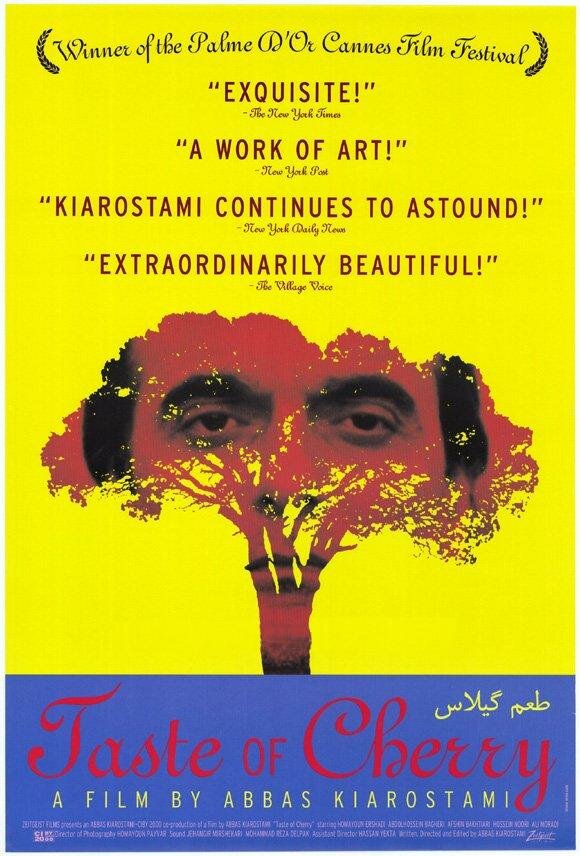
Kiarostami reached the zenith of international acclaim in 1997 when he was awarded the Palme d'Or at Cannes for Taste of Cherry. The film, a meditative journey of a man driving through the outskirts of Tehran looking for someone to bury him after his suicide, was a masterclass in narrative restraint. It famously ended by breaking the "fourth wall," revealing the film crew and reminding the audience that cinema is a construction. For Kiarostami, the viewer was an active participant; he famously said he preferred films that "put the audience to sleep" only to wake them up with something that stayed with them for years, challenging the passive consumption of Hollywood spectacles.
In his later years, Kiarostami proved he was as much a digital pioneer as he was a traditionalist. He embraced small, handheld digital cameras for projects like 10 (2002), which stripped cinema down to its barest essentials: ten conversations inside a car. He eventually moved beyond the borders of Iran to film Certified Copy (2010) in Italy and Like Someone in Love (2012) in Japan. These films explored the "original vs. copy" theme, suggesting that a well-crafted performance of love or identity is often more "real" than the truth it replaces. His ability to maintain his distinct voice while working in foreign languages and cultures cemented his status as a truly global auteur.
When Kiarostami passed away in Paris in 2016, the cinematic world lost its most grounded visionary. Beyond his films, he left behind a rich body of photography and poetry, all characterized by the same "Zen-like" appreciation for the mundane—the snow on a hill, the rain on a windshield, or a lone tree in a field. Jean-Luc Godard once famously remarked that "Film begins with D.W. Griffith and ends with Abbas Kiarostami." While cinema has certainly continued, it does so in the shadow of a man who taught us that if you look at the ordinary long enough, it eventually reveals the sublime.
