

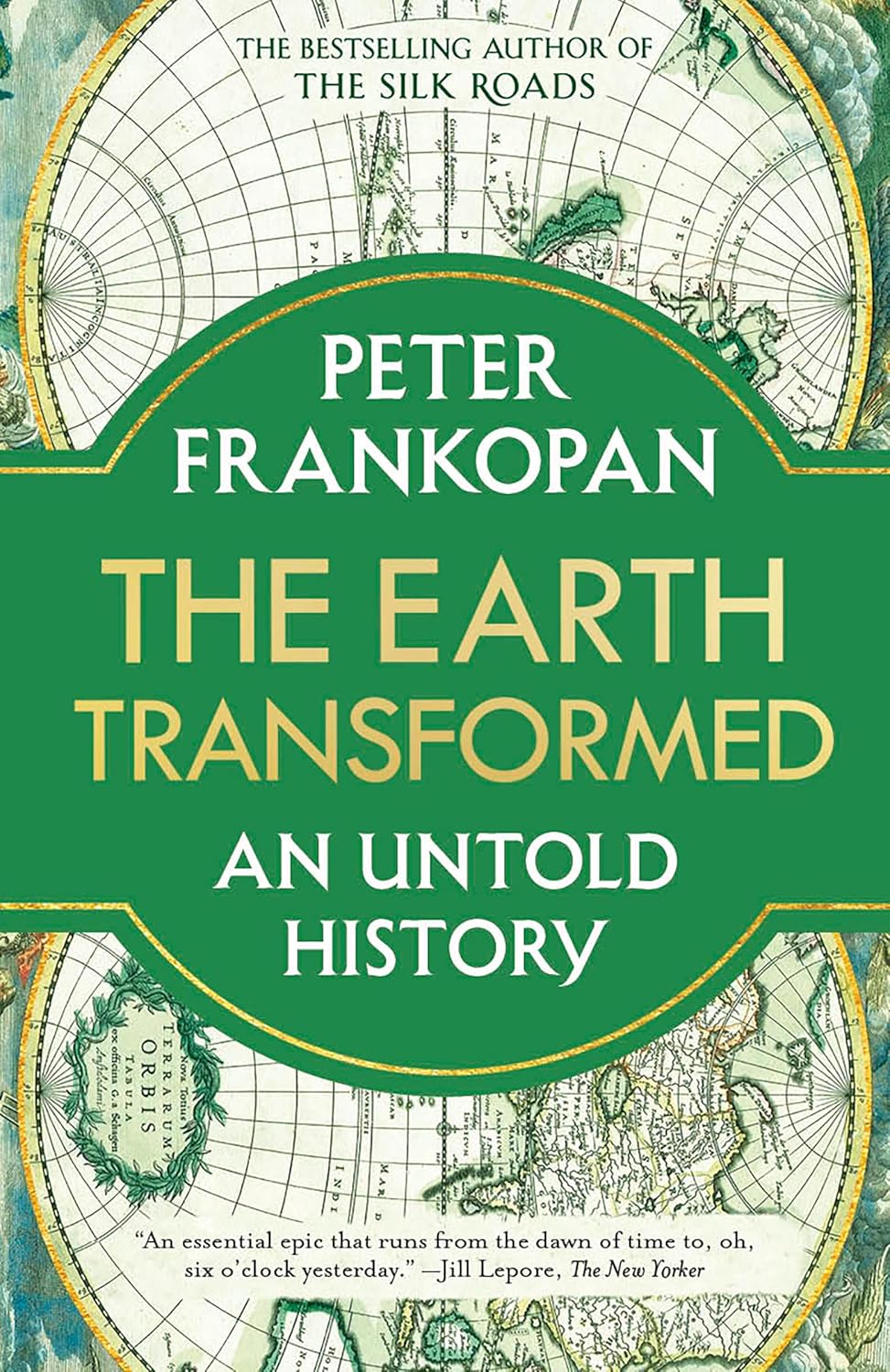
In The Earth Transformed: An Untold History, historian Peter Frankopan attempts something truly audacious: to tell the story of human civilisation with the natural environment—not human ambition or political scheming—as the central character. The result is a hefty, ambitious, and often sobering work that fundamentally reorients how we think about the past.
Frankopan’s main argument is simple yet profound. Nature isn’t just a backdrop to history; it is the very stage on which our existence plays out. For most of human history, that stage has been shaped by forces far beyond our control: volcanic eruptions, solar activity, shifting ocean currents, and devastating plagues. Frankopan shows again and again how climate contributed to the rise and fall of empires, from the Moche civilisation in South America undone by El Niño to the Ottoman Empire weakened by volcanic ash drifting from Iceland. He even suggests that Genghis Khan owed part of his success to an unusually wet period that turned Mongolia’s pastures lush. These stories are fascinating and often surprising, making a powerful case that ignoring the environment means missing half the picture.
Where the book truly shines is in its sheer scope and Frankopan’s talent for synthesis. He draws on a dazzling array of scientific disciplines—ice cores, fossilised pollen, tree rings, and the chemical composition of shells—to build his narrative. The writing is surprisingly readable for an Oxford professor, with a lively, urgent tone and welcome flashes of wit, like his memorable declaration that “the humble potato changed the world”. He is also scrupulously fair in his coverage, treating the histories of Oceania, the Mississippi valley, and the Sahel with the same weight as those of the Roman or Ming empires. This global perspective is one of the book’s greatest strengths, breaking free from a traditional Eurocentric view of the past.
At its heart, The Earth Transformed is a deeply pessimistic book. Frankopan’s central thesis is a downbeat one, and he makes no secret of his alarm. The story he tells is essentially one of repeated catastrophe: one damn eruption, flood, drought, and famine after another. He is careful to avoid simple climate determinism, acknowledging that poor human decisions often compounded environmental pressures. However, the relentless accumulation of crises can become exhausting, making the book a difficult read at times. For the first 600 pages, you might find yourself wondering where the broader argument is heading beyond the fact that history is, and always has been, a series of environmental disasters.
That said, the book is not without its flaws. Its greatest weakness is also its greatest strength: its ambition. At over 700 pages, it is a sprawling behemoth, and the focus can sometimes wander. The reader is often in danger of being overwhelmed by the sheer volume of examples, losing sight of the historical forest for the countless trees. Some sections, such as the brief treatment of 20th-century oil geopolitics, feel like potted summaries that lack the depth of more focused specialist works. It is a work of breathtaking synthesis, but that synthesis comes at the cost of a certain analytical precision.
Ultimately, The Earth Transformed is a vital and necessary book, even if it is not an easy one. Frankopan’s final argument, which he only fully unleashes in the last hundred pages, is devastating: the 20th century was the warmest period of the last two millennia, and this is no coincidence. For the first time, humanity itself has become the primary driver of climate change. This is not a book you read for comfort, but for context. It reframes our current crisis not as an unprecedented anomaly, but as the latest chapter in a long, violent, and deeply entangled relationship between our species and our planet. It is a formidable achievement, and a sobering warning we would be foolish to ignore.