

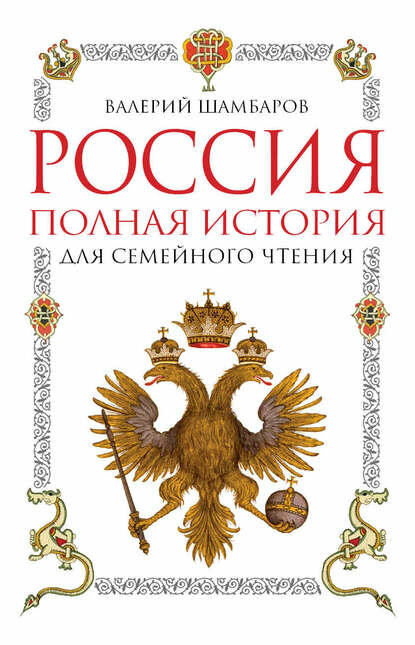
Valery Shambarov’s Russia: A Complete History for Family Reading is an ambitious attempt to reclaim the national narrative for the general public. In an era where history is often either buried in academic jargon or fragmented by political revisionism, Shambarov seeks to provide a “holistic” view. As the title suggests, the book is written with an instructional but engaging tone, aimed at a multi-generational audience. It positions Russian history not as a series of disconnected accidents, but as a grand, purposeful journey of a unique civilization.
The core philosophy of the book is rooted in traditionalism and patriotism. Shambarov focuses on the “bright” threads of the Russian story—valor in battle, the wisdom of saints, and the resilience of the common person. He treats the transition from the pagan tribes to the Christianized Kievan Rus, and eventually to the Moscow Tsardom, as a natural evolution of the national spirit. While it covers the “heavy” hitters like Ivan the Terrible and Peter the Great, it spends significant time on the cultural and spiritual milestones that Shambarov believes define the Russian soul.
What makes this work “family-friendly” is its storytelling pace. Shambarov has a knack for highlighting the anecdotal and the dramatic, making historical figures feel like characters in a sprawling family saga. He avoids the “de-mystification” seen in Book 12 (Nefedov); instead, he leans into the legendary aspects of the past, arguing that a nation’s myths are just as important as its tax records. The prose is fluid and evocative, designed to be read aloud or discussed at a dinner table, fostering a sense of shared heritage.
However, a candid assessment requires noting that Shambarov is a passionate “apologist” for the Russian state. He frequently takes aim at Western historiography, which he believes has unfairly maligned Russian leaders and traditions for centuries. In his view, many of the “atrocities” attributed to Russian Tsars are either exaggerations or standard practices for the era. This makes the book a fascinating look at the “counter-narrative” that has become increasingly popular in contemporary Russia—a push to view the past through a lens of strength rather than apology.
The book’s scope is truly impressive, spanning from the legendary “Arrival of the Varangians” to the complexities of the Soviet collapse and the emergence of the modern Russian Federation. By including the 20th and 21st centuries, Shambarov attempts to heal the “break” in history caused by the 1917 Revolution, showing how the Russian people survived ideological shifts while maintaining their core identity. It is a work of reconciliation, trying to find a common ground where the Imperial and Soviet eras can coexist in the national memory.
Ultimately, Russia: A Complete History for Family Reading is an essential pick for anyone wanting to understand the modern Russian “mainstream” view of their own past. It is not an objective academic textbook, nor does it pretend to be. It is a work of “history-building” intended to inspire pride and a sense of continuity. If you want to know the stories that a Russian grandfather might want his grandson to remember, this is the book that contains them.