

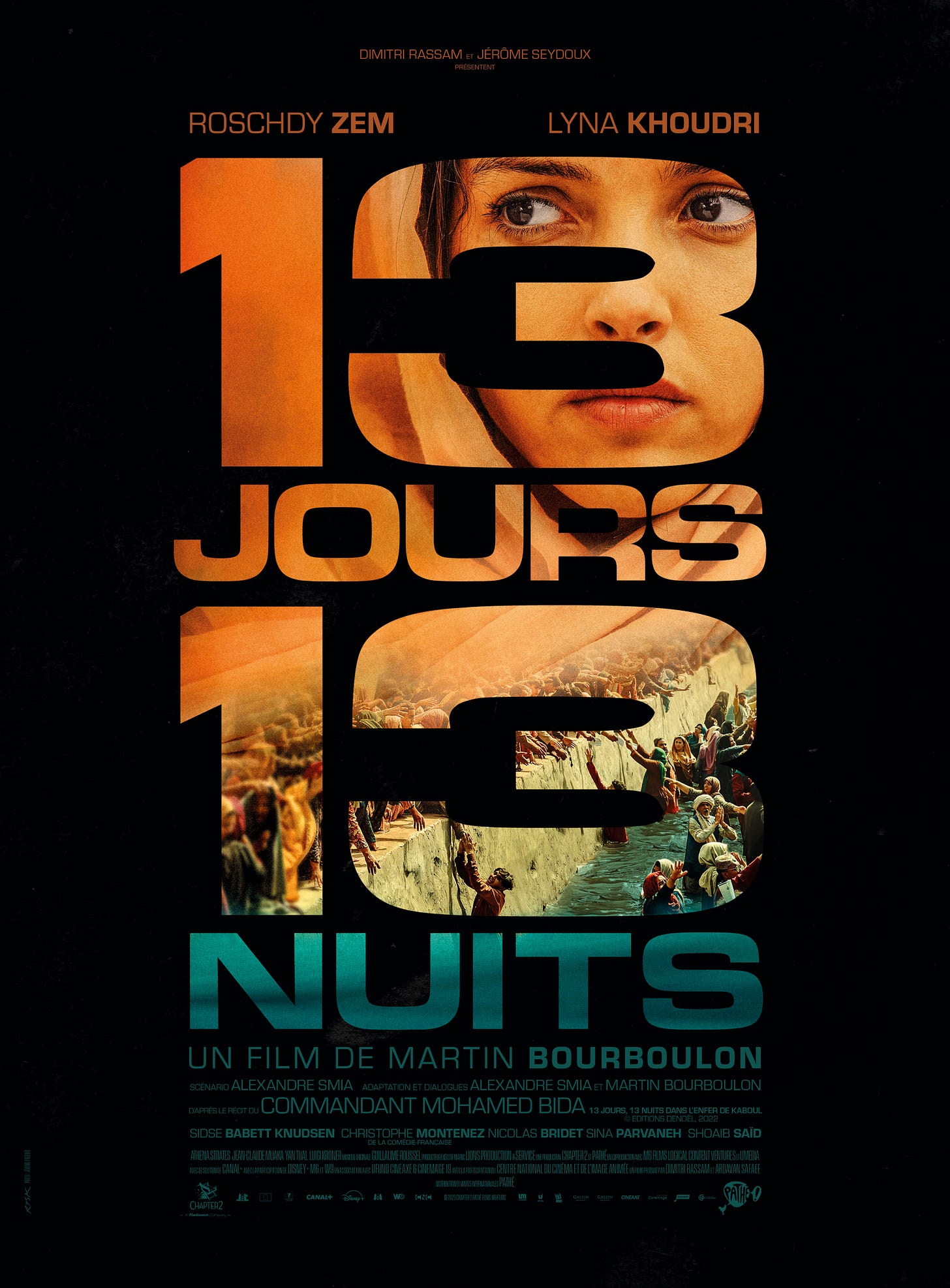
Directed by Martin Bourboulon, 13 Jours, 13 Nuits (13 Days, 13 Nights) is a French political thriller based on Mohamed Bida’s memoir, recounting the harrowing 2021 evacuation of the French Embassy in Kabul during the Taliban’s takeover. The film, starring Roschdy Zem, Lyna Khoudri, and Sidse Babett Knudsen, attempts to blend visceral action with moral complexity, but struggles under the weight of its ambitious premise, earning a lukewarm reception (IMDb 6.8, Douban 6.3).
Strengths
Authenticity and Urency: The film’s foundation in Bida’s firsthand account lends it a gritty realism. Scenes depicting chaotic checkpoints, frantic negotiations, and civilian panic are staged with intensity, immersing viewers in the visceral chaos of the Kabul airport evacuation. The use of multinational actors (e.g., Danish Knudsen, Algerian-French Khoudri) underscores the crisis’s global stakes.
Performances: Roschdy Zem anchors the film as Bida, the embattled commander torn between duty and desperation. His stoic resolve contrasts effectively with Khoudri’s Eva, a French diplomat grappling with guilt over abandoning local staff. Knudsen, as a seasoned negotiator, adds gravitas to tense diplomatic standoffs, though her arc feels underdeveloped.
Technical Craftsmanship: Cinematographer Nicolas Bolduc captures Kabul’s oppressive atmosphere through desaturated visuals and shaky handheld camerawork, evoking a sense of claustrophobia. Guillaume Roussel’s score amplifies tension with discordant strings and percussive beats.

Weaknesses
Pacing and Tonal Inconsistency: The film oscillates between frenetic action sequences (e.g., a harrowing convoy ambush) and plodding dialogue-driven scenes. While Bourboulon excels at staging set pieces, the narrative stalls during expository exchanges, diluting momentum. A subplot involving a civilian family’s plight feels shoehorned, lacking emotional resonance.
Shallow Characterization: Despite strong performances, characters remain archetypal. Bida’s internal conflict—torn between professionalism and empathy—is hinted at but never fully explored. Supporting roles, including Martin (Christophe Montenez), a French soldier, and Amina (Fatima Adoum), an Afghan interpreter, are reduced to plot devices, their motivations left unexamined.
Didacticism and Moral Ambiguity: The film’s climax attempts to provoke reflection on Western interventionism, but its heavy-handed symbolism (e.g., a child’s torn passport) feels forced. Critics have noted a “selective humanism” in its portrayal of suffering, prioritizing Western protagonists over Afghan civilians, which undermines its anti-war message.
Cultural Appropriation Concerns: Some reviewers have questioned the ethics of a French production centering a French-led evacuation, arguing it sidelines Afghan voices. While Bida’s memoir provides authenticity, the film’s lens remains predominantly Western, reinforcing colonial narratives of “saving” the Global South.
Comparison to Peers
Unlike Dunkirk (2017), which weaves multiple perspectives into a cohesive tapestry of survival, 13 Jours struggles to balance its ensemble cast, resulting in fragmented storytelling. Its approach also pales next to Hotel Rwanda (2004), which similarly tackles evacuation under genocide but prioritizes intimate character studies over spectacle. The film’s action-heavy tone aligns it closer to 13 Hours: The Secret Soldiers of Benghazi (2016), though it lacks that film’s visceral impact.
Conclusion
13 Jours, 13 Nuits is a competently made but ultimately uneven thriller that captures the chaos of the Kabul evacuation without delving into its moral complexities. While its technical prowess and committed performances impress, the script’s pacing issues and shallow characterizations prevent it from transcending genre conventions. Viewers seeking a nuanced exploration of war’s human cost may find it lacking, though fans of high-stakes action will appreciate its tense set pieces. Ultimately, the film serves as a reminder of cinema’s power—and limitations—in reckoning with geopolitical trauma.
Rating: ★★★☆☆ (3/5)