

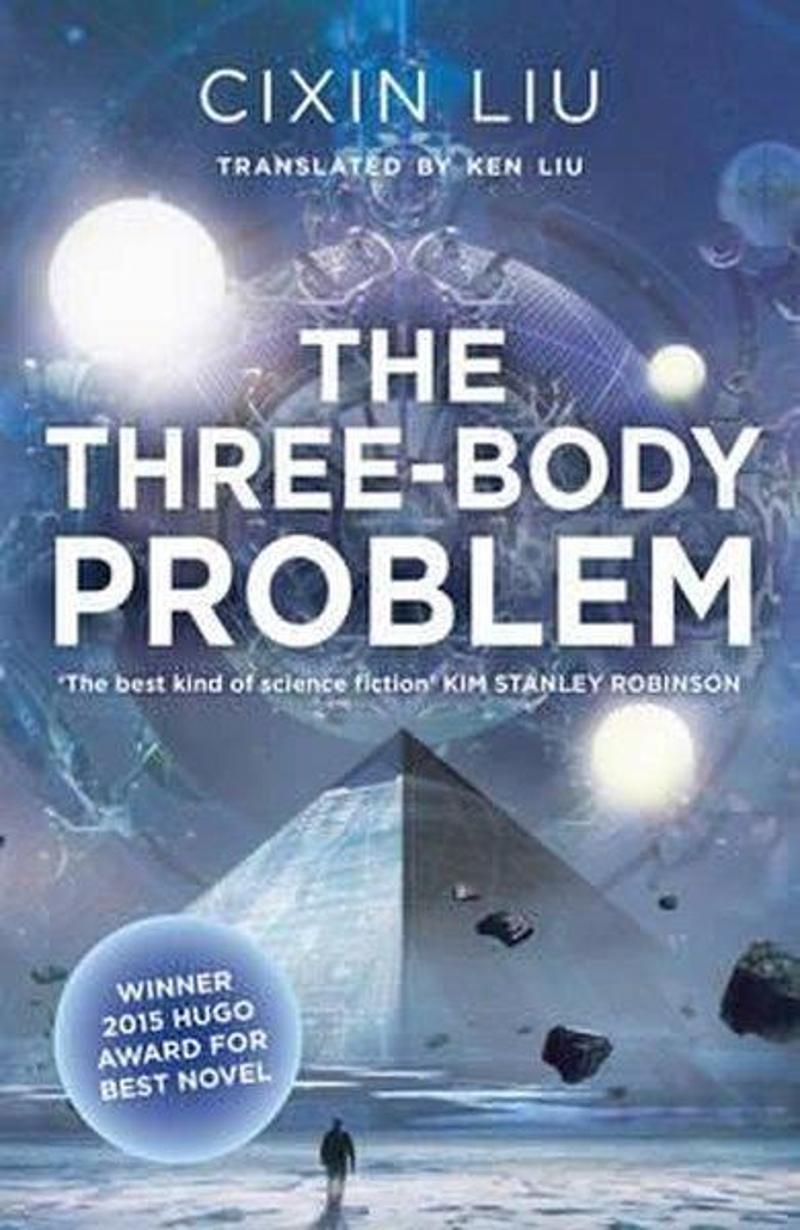
Liu Cixin’s The Three-Body Problem is a groundbreaking entry into the realm of hard science fiction, bringing with it a distinctly Chinese perspective and a deeply philosophical approach to humanity’s place in the cosmos. The novel, the first in the Remembrance of Earth’s Past trilogy, explores humanity’s first contact with an alien civilization through a blend of astrophysics, political history, and psychological tension.
At the heart of the narrative is Ye Wenjie, an astrophysicist whose disillusionment with humanity—sparked by her father’s death during the Cultural Revolution—leads to a fateful decision that shapes the fate of Earth. Her character serves as a bridge between the human and the cosmic, between 20th-century trauma and 21st-century existential risk.
Wang Miao, a nanomaterials scientist, becomes the reader’s primary lens into a mysterious virtual world and a broader conspiracy involving secret military operations, suicides among top scientists, and a puzzling video game called “Three Body.” The game, in which players try to understand a world with three suns and chaotic cycles, serves as a metaphor and mechanism for the alien Trisolaran civilization’s struggle—and becomes a vehicle for revealing their eventual plans for Earth.
The novel is densely packed with scientific theory, particularly in the realm of physics and astronomy, but Liu Cixin succeeds in making these concepts accessible and often thrilling. Unlike many Western sci-fi works that rely heavily on character drama, The Three-Body Problem leans into the awe of cosmic perspective and the cold logic of survival.
Liu’s prose, elegantly translated by Ken Liu, balances philosophical inquiry with moments of intense suspense. The narrative may feel methodical or emotionally distant to some readers, but this tone reinforces the book’s core themes: the vastness of time, the fragility of civilization, and the terrifying consequences of contact with an unknowable other.
What truly sets The Three-Body Problem apart is its cultural context. Drawing on China’s history—especially the Cultural Revolution—and its modern scientific ambitions, the novel frames humanity’s existential questions within a uniquely Chinese narrative. This makes it not just a sci-fi epic but a geopolitical commentary on technological progress, trust, and betrayal.
There’s a haunting realism to Liu’s depiction of human nature under pressure. While some characters make morally questionable choices, the author doesn’t frame them as villains or heroes. Instead, he presents a sobering view of how ideology, trauma, and fear can influence decisions with planetary consequences.
The novel also introduces one of the most intriguing alien civilizations in modern science fiction. The Trisolarans are not just invaders; they are beings shaped by an unstable solar system, whose desperation makes them both threatening and tragic. Their motivations are rooted in survival, not malice, which challenges the reader to reconsider black-and-white notions of good and evil.
Ultimately, The Three-Body Problem is a masterclass in scale and imagination. It sets up questions that will echo throughout the rest of the trilogy and leaves the reader with a sense of wonder—and dread—about the universe’s vast unknowns. It is not only an essential read for science fiction fans but also for anyone interested in how literature can bridge cultures and philosophies.
In conclusion, Liu Cixin’s novel is a rare blend of scientific depth, philosophical weight, and geopolitical resonance. It invites the reader not just to imagine aliens, but to grapple with the human reactions to them—and to ask whether we’re truly ready to face what lies beyond the stars.