

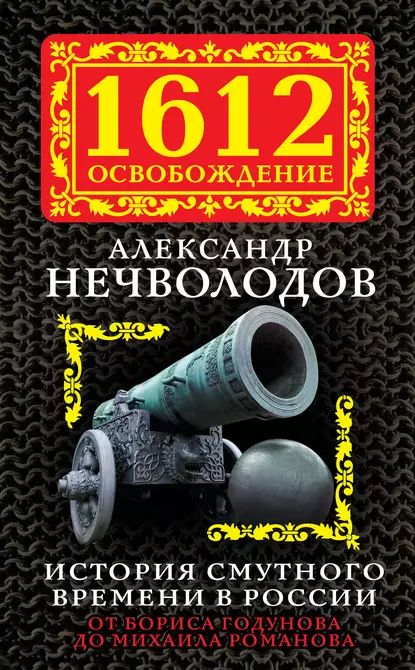
Alexander Nechvolodov was not a typical “dry” academic; he was a Lieutenant General of the Russian Imperial Army. This background is vital to understanding his work. Writing on the eve of World War I and the Russian Revolution, Nechvolodov produced a history of the “Smuta” (Time of Troubles) that reads like a warning and a rallying cry. He focuses on the period where the Rurik dynasty ended, the throne became a revolving door for pretenders, and the very existence of Russia as a sovereign state hung by a thread.
The narrative begins with the death of Ivan the Terrible’s sons and the rise of Boris Godunov. Nechvolodov masterfully depicts the psychological atmosphere of the era—a mix of superstitious dread, famine-induced desperation, and political betrayal. He treats the “False Dmitrys” (pretenders to the throne) not just as individual imposters, but as symptoms of a deep-seated social illness. To Nechvolodov, the “Troubles” were a test of the national spirit, a moment when the elite failed and the survival of the country fell to the common people.
One of the strengths of this work is its vivid portrayal of the “National Militia.” Nechvolodov highlights the roles of Kuzma Minin and Prince Dmitry Pozharsky, framing them as the ultimate embodiments of Russian patriotism. As a military man, he provides excellent tactical context for the liberation of Moscow in 1612. However, he also gives significant weight to the spiritual resistance led by Patriarch Hermogenes, arguing that the Orthodox Church provided the “moral glue” that kept the fragmented provinces from drifting apart.
Nechvolodov’s style is unapologetically “monarchist” and traditional. He wrote this for a wide audience—from students to soldiers—aiming to inspire a sense of continuity and pride. His prose is clear, evocative, and deeply colored by his love for the “Old Russia.” While modern historians might point to his lack of critical distance regarding the Romanov dynasty’s ascent, his ability to synthesize a dizzying array of coups, invasions, and uprisings into a coherent, compelling story is undeniable.
The book also delves into the foreign interventions of Poland and Sweden. Nechvolodov describes the Siege of the Trinity Lavra of St. Sergius with cinematic intensity, using it as a microcosm for the larger struggle. He emphasizes that the “Troubles” were ended not just by a military victory, but by a social contract—the Zemsky Sobor of 1613, which elected Mikhail Romanov. For Nechvolodov, this was the moment the “Russian Land” reasserted its will over the “vortex of chaos.”
Ultimately, Nechvolodov’s History of the Time of Troubles is a classic of pre-revolutionary historiography. It offers a window into how the Russian Empire viewed its own foundations just before that empire itself collapsed into a new “Time of Troubles” in 1917. It’s a book about resilience, the danger of internal division, and the belief that even from the brink of total annihilation, a nation can find its way back to order. It remains one of the most readable and passionate accounts of Russia’s darkest hour.