

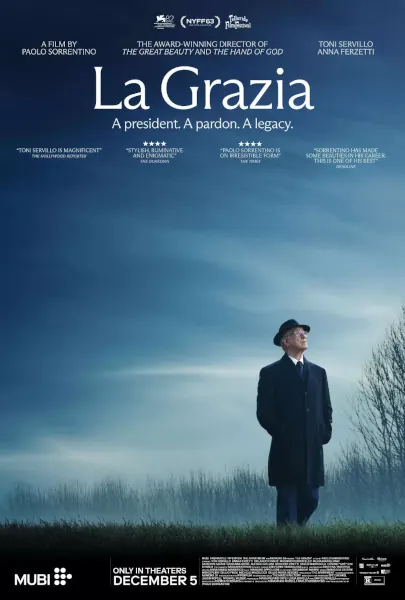
When Paolo Sorrentino unveiled La grazia as the opening film of the 82nd Venice International Film Festival in late August 2025, the occasion carried the gravity of a state visit. Here was Italy’s most internationally celebrated auteur returning to the Lido with his longtime muse, Toni Servillo, to present a film about the Italian presidency itself—a subject Sorrentino had approached before, though never with such deliberate restraint. What emerged was not the baroque spectacle of Il Divo or the decadent pageantry of The Great Beauty, but something rarer: a quiet, autumnal meditation on power, mortality, and the excruciating privilege of deciding who deserves to live and who deserves to die. For a director whose visual exuberance has occasionally threatened to eclipse his human concerns, La grazia represents a startling, and welcome, modulation toward introspection.
The film centers on Mariano De Santis, a fictional President of Italy portrayed by Servillo with the kind of monumental stillness that only a handful of living actors can command. Entering the final six months of his term—a period Italians call the semestre bianco, or white semester—De Santis finds himself spiritually becalmed. His wife Aurora has been dead for eight years, yet her ghost lingers not as comfort but as unresolved accusation: a mutual friend eventually reveals that Aurora committed adultery four decades prior, a betrayal that De Santis, nicknamed “Reinforced Concrete” for his unwavering juridical temperament, cannot metabolize. Meanwhile, three fateful matters demand his attention before he leaves office: a bill to legalize euthanasia, championed by his daughter; a pardon petition from a young woman who murdered her abusive husband; and another from an elderly man who killed his wife in the terminal stages of Alzheimer’s disease. These are not abstract political dilemmas but moral crucibles, and Sorrentino stages them with the understanding that a president cannot seal his personal grief in a separate compartment from the laws he signs.
Servillo’s performance, which deservedly earned him the Volpi Cup for Best Actor at Venice, is a masterclass in negative capability. He gives us a man who has built an entire public persona on certainty—De Santis is a devout Catholic, a former constitutional judge, a figure of institutional gravity—yet who is privately unmoored by doubt. Watch the way Servillo occupies space in the Quirinale’s corridors: the slight hesitation before entering a room, the practiced smile that never quite reaches his eyes, the furtive cigarettes snatched on rooftop terraces overlooking Rome. It is a performance built on withholding, on the eloquence of silence and the architecture of a face that seems to have absorbed decades of Italian history. When De Santis discovers his wife’s infidelity, Servillo does not erupt; he contracts, as if the air itself has been stolen from his lungs. The actor understands that for a man of this temperament, shame is not shouted but suffocated.
At its core, La grazia is an inquiry into grace itself—la grazia meaning both divine favor and, in legal Italian, the presidential pardon. Sorrentino, who has cited a real pardon granted by President Sergio Mattarella as inspiration, is less interested in the machinery of governance than in the metaphysics of mercy. The euthanasia debate becomes a lens through which to examine who owns our final days; the pardon petitions ask whether justice can ever be separated from empathy. Sorrentino does not offer easy answers, nor does he condescend to his audience with false equivalence. Instead, he allows the arguments to unfold through conversations that feel genuinely dialectical—particularly between De Santis and his daughter Dorotea, played by Anna Ferzetti with a warmth that earned her the festival’s Pasinelli Award. Their debates are not scripted op-eds but the negotiations of love, shot through with the particular exasperation of a child who has become her father’s caretaker and conscience.
Visually, the film marks a significant evolution for Sorrentino and his cinematographer, Daria D’Antonio. Gone, for the most part, are the frenetic tracking shots and Fellini-esque carnival sequences that defined The Great Beauty and Youth. In their place is a more ascetic, chamber-piece aesthetic: the film unfolds largely within the gilded, suffocating interiors of state power—Turin’s Castello del Valentino, Moncalieri Castle, the Baroque labyrinths of government—where history presses against the present like a palimpsest. When Sorrentino does open the frame to the outside world, the effect is almost transcendent: a shaft of Roman sunlight over the hills, an astronaut floating in zero gravity whose tear drifts weightlessly toward the camera, a image De Santis watches on a monitor, reaching out as if to touch the grief he recognizes in another’s isolation. These moments of visual respite are earned, not decorative, and they lend the film a spiritual register that its more flamboyant predecessors often merely approximated.
The father-daughter dynamic is the emotional spine of the picture, and it is here that Sorrentino’s screenplay achieves its most humane register. Dorotea is not merely a political advisor or a plot device; she is the bridge between her father’s antiquated codes of honor and the moral imperatives of a changing Italy. Ferzetti plays her with a pragmatic tenderness, a woman who has learned to navigate her father’s silences and who understands that his procrastination on the euthanasia bill is not political cowardice but existential paralysis. Their scenes together—whether debating legislation over quinoa dinners (Dorotea has put the President on a strict health regimen) or visiting prisoners in the misty north—carry the weight of shared history without ever lapsing into sentimentality. It is, arguably, the most fully realized relationship Sorrentino has ever committed to film.
In the context of Sorrentino’s filmography, La grazia arrives as a work of late style—not the explosive late style of a artist raging against the dying of the light, but the measured, contemplative late style of someone who has learned that restraint can be more devastating than excess. The film is not without its indulgences: a robot dog that wanders through the Quirinale, a cameo by rapper Guè Pequeno that feels more like a nod to Sorrentino’s eternal preoccupation with Italian cool than a narrative necessity, and a Black Pope (played by Rufin Doh Zeyenouin) who cruises the Vatican gardens on a motor scooter. Yet even these eccentricities feel integrated into a broader tonal fabric, moments of surreal levity that prevent the film from calcifying into pure solemnity. Sorrentino seems to have absorbed the lesson that grace, like humor, often arrives unbidden.
La grazia is not a film that clamors for attention; it earns it, slowly, through the accumulated force of its intelligence and compassion. At 133 minutes, it asks for a patience that contemporary cinema rarely demands, and it rewards that patience with a final movement of genuine emotional clarity. De Santis’s journey is not toward certainty but toward a kind of wounded wisdom—the recognition that to govern is to live with doubt, and that to pardon, whether legally or spiritually, is to acknowledge the limits of one’s own judgment. In an era when political cinema often devolves into caricature or sermon, Sorrentino has made a film about power that is finally, and movingly, about powerlessness: the powerlessness of love to prevent betrayal, of law to resolve moral ambiguity, and of age to outrun grief. It is, in the end, a film about learning to fall—and finding, in the falling, something like grace.