

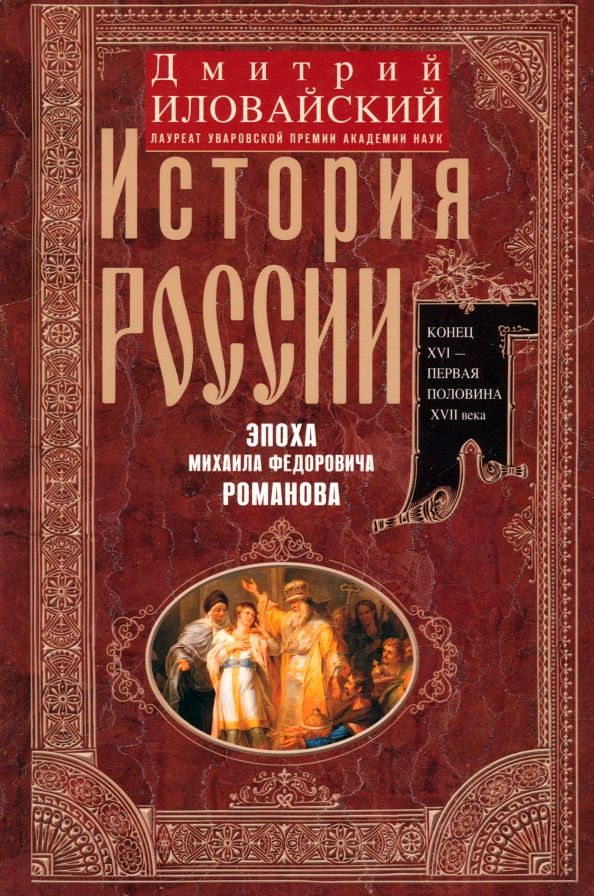
Dmitry Ilovaysky’s monograph on the era of Mikhail Fedorovich, the first Romanov Tsar, is a masterpiece of “reconstruction.” While his predecessor Sergey Solovyov looked at the broad sociological laws of the state, Ilovaysky was a master of the narrative and the character study. He presents the early 17th century not just as a sequence of treaties, but as a grueling period of healing. After the fires of the Smuta, the country was a hollow shell, and Ilovaysky brilliantly captures the tentative, often desperate steps taken by the young Tsar and his father, Patriarch Filaret, to restore the dignity of the throne.
The central theme of the work is the “Restoration of Order.” Ilovaysky describes a Russia that was physically ruined—villages burned, treasury empty, and borders porous. He pays meticulous attention to the Zemsky Sobors (National Assemblies), which he views as a unique Russian form of “popular monarchy.” In his view, Mikhail Fedorovich was not a tyrant but a “chosen” leader whose legitimacy came from the consensus of all classes of society. This conservative-monarchist perspective emphasizes the deep bond between the people and the dynasty as the only safeguard against chaos.
Ilovaysky is particularly skilled at depicting the shadow ruler of the era: Patriarch Filaret. The author shows how the Tsar’s father, returning from Polish captivity, brought a much-needed iron will to the Kremlin. The book explores the complex “diarchy” where the spiritual and secular powers worked in tandem to stabilize the currency, rebuild the army, and push back against the lingering threats from Sweden and Poland. For Ilovaysky, this period was the triumph of the Orthodox tradition as a governing principle.
The prose is characteristically “Imperial”—stately, clear, and unburdened by the Marxist jargon that would later dominate Russian historiography. Ilovaysky was a populist in his day; he wrote for a wide audience, and his storytelling reflects that. He has a keen eye for “human” details: the Tsar’s health, the court ceremonies, and the slow, grinding return of trade to the Moscow streets. He makes the bureaucratic process of rebuilding a state feel like a heroic endeavor.
A “candid” note for the modern reader: Ilovaysky was a staunch defender of the autocracy and often clashed with more liberal or radical thinkers of his time. He emphasizes the “benevolent” nature of the early Romanovs, sometimes smoothing over the harshness of the strengthening serfdom. However, his work remains invaluable because of its exhaustive use of archival sources. He provides a wealth of detail on the “Smolensk War” and the diplomatic missions of the era that few modern syntheses can match.
Ultimately, this book is a celebration of resilience. It tells the story of how a nation that had effectively “died” during the Troubles managed to find its pulse again. Ilovaysky shows that the Romanov dynasty didn’t start with the splendor of Peter the Great, but with the quiet, persistent labor of a young man and his father in a city of ashes. For anyone interested in how institutions are built from nothing, Ilovaysky’s account of the first Romanov is a foundational text.