Origins and Formation: From the Shanghai Five to the SCO
The institutional trajectory of the Shanghai Cooperation Organisation began in April 1996 as the “Shanghai Five,” a diplomatic mechanism comprising China, Russia, Kazakhstan, Kyrgyzstan, and Tajikistan established to resolve complex boundary disputes inherited from the dissolution of the Soviet Union. This initial framework culminated in the 1996 Agreement on Confidence Building in the Military Field in the Border Area and the 1997 Agreement on Mutual Reduction of Military Forces, effectively transforming former militarized zones into regions of cooperative engagement. The nascent organization operated on principles of mutual trust, equal consultation, and peaceful resolution of territorial conflicts, successfully demarcating over 7,000 kilometers of previously contested borders through dialogue rather than confrontation.
The pivotal transformation occurred on 15 June 2001 in Shanghai, when Uzbekistan acceded to the mechanism, necessitating the reconstitution of the group as the Shanghai Cooperation Organisation. The founding states signed the Declaration on the Establishment of the SCO and the Shanghai Convention on Combating Terrorism, Separatism, and Extremism, thereby codifying the “Shanghai Spirit”—a foundational doctrine emphasizing mutual trust, mutual benefit, equality, consultation, respect for diverse civilizations, and pursuit of common development. Unlike its predecessor’s exclusive focus on border demilitarization, the newly chartered organization expanded its remit to encompass regional security, economic cooperation, and cultural exchange, establishing itself as a permanent intergovernmental entity with aspirations for broader Eurasian integration.
Institutionalization and Legal Architecture
The SCO’s transition from ad hoc diplomatic gatherings to a structured international organization was formalized on 7 June 2002, when member states signed the SCO Charter in Saint Petersburg, which entered into legal force on 19 September 2003. This foundational document delineated the organization’s objectives, operational principles, and institutional framework, establishing a consensus-based decision-making model that required unanimity among all members for substantive resolutions. The Charter created a lean bureaucratic structure comprising solely two permanent organs: the Secretariat, headquartered in Beijing to handle administrative and organizational functions, and the Regional Anti-Terrorist Structure (RATS), established in Tashkent, Uzbekistan, to coordinate counter-terrorism intelligence and operations.
The institutional architecture prescribed by the Charter established a tiered hierarchy of decision-making bodies, with the Council of Heads of State serving as the supreme authority meeting annually on a rotating basis determined by Cyrillic alphabetical order. Subordinate to this, the Council of Heads of Government (Prime Ministers) convenes to oversee economic cooperation and budgetary matters, while the Council of National Coordinators maintains continuous diplomatic liaison. The Charter mandated Russian and Chinese as the sole official and working languages—a deliberate linguistic binary reflecting the organization’s geopolitical orientation—while explicitly leaving provisions for future expansion and the creation of specialized agencies open to subsequent interpretation and development.
Geographic Expansion: The First Enlargement Wave
For the initial decade of its existence, the SCO maintained a moratorium on full membership expansion, focusing instead on consolidating internal cohesion and establishing observer-state mechanisms. Mongolia became the first observer in 2004, followed by the strategically significant admission of India, Iran, and Pakistan as observers at the 2005 Astana Summit—a development that presaged the organization’s eventual southward geographic extension. During this period, the SCO formulated the Regulations on Dialogue Partners (2009), creating a graduated accession pathway whereby interested states could deepen institutional engagement without immediate full membership, a mechanism utilized by Azerbaijan, Armenia, Cambodia, and Nepal among others.
The organization’s first substantive enlargement materialized at the 9-10 June 2017 Astana Summit, when India and Pakistan formally acceded as full members following the completion of extensive memoranda of obligations signed in 2016. This expansion fundamentally altered the SCO’s demographic and geographic composition, transforming it from a Central Asia-centric entity into a pan-Eurasian organization encompassing nearly half of the world’s population and extending from the Arctic to the Indian Ocean. The accession ceremony, marked by the raising of Indian and Pakistani national flags alongside the emerald-blue SCO standard at the Beijing Secretariat on 15 June 2017, symbolized the organization’s successful absorption of historically antagonistic nuclear powers while maintaining functional coherence through its consensus-based framework.
Contemporary Enlargement and Current Architecture
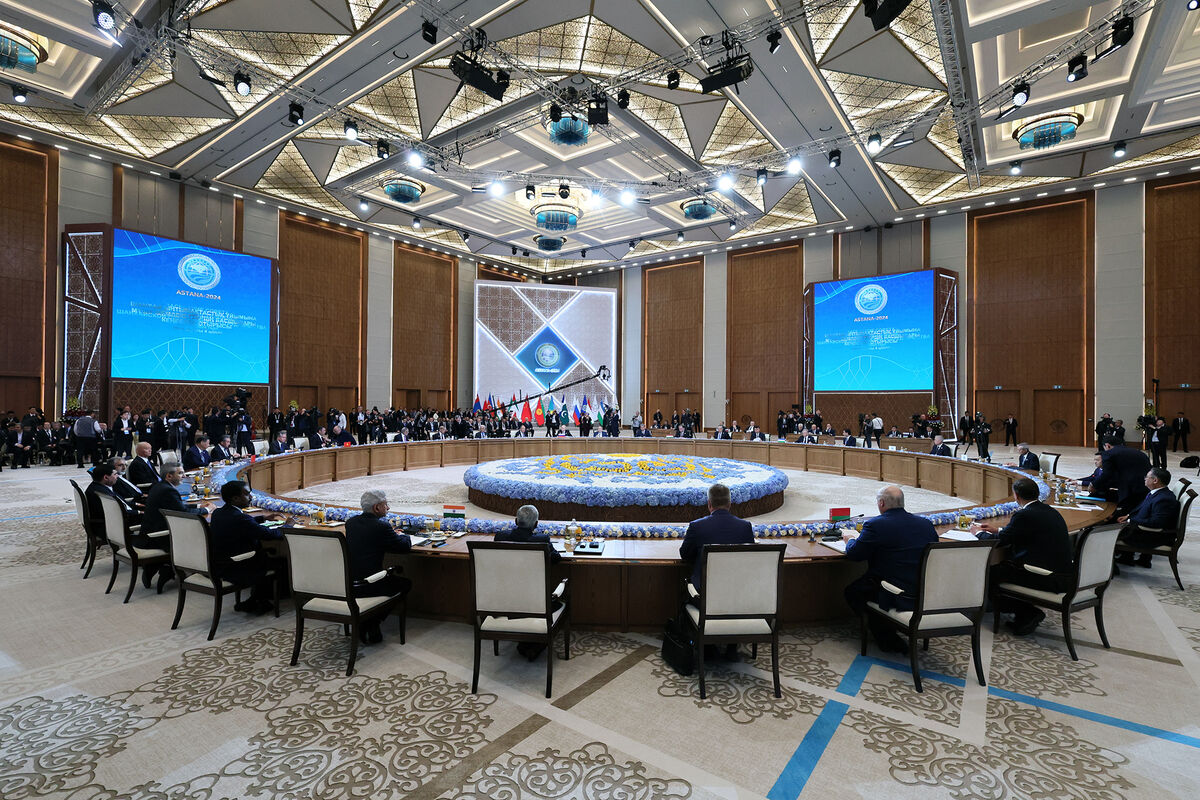
The SCO’s second wave of expansion commenced with the admission of the Islamic Republic of Iran as a full member state on 4 July 2023, during the virtual New Delhi-hosted summit, fulfilling an accession process initiated over fifteen years prior when Tehran first sought membership. This was followed by the accession of Belarus on 4 July 2024 at the Astana Summit, augmenting the membership roster to ten states and extending the organization’s reach into Eastern Europe. Belarus’s progression from dialogue partner (2009) to observer (2015) to full member exemplifies the organization’s methodical accession criteria requiring demonstrated commitment to the Shanghai Spirit and fulfillment of specific economic, legal, and security protocols.
As of 2024, the SCO encompasses ten full member states—China, Russia, Kazakhstan, Kyrgyzstan, Tajikistan, Uzbekistan, India, Pakistan, Iran, and Belarus—alongside two observer states (Afghanistan and Mongolia) and fourteen dialogue partners including Saudi Arabia, Egypt, Qatar, and the United Arab Emirates. This configuration covers approximately 80 percent of Eurasian landmass, represents nearly 45 percent of global population, and accounts for over 25 percent of world GDP, rendering the SCO the largest regional organization by geographic scope and demographic representation. The inclusion of civilizations spanning Slavic Orthodox, Confucian, Islamic, Hindu, and Persian traditions has necessitated sophisticated diplomatic calibration to preserve organizational unity while accommodating divergent strategic cultures and geopolitical interests.
Functional Evolution: From Border Security to Multipolar Governance
The SCO’s functional evolution reflects a trajectory from narrow military confidence-building to comprehensive regional governance architecture. Initially conceived to manage post-Soviet territorial demarcation, the organization rapidly pivoted following the 11 September 2001 attacks toward counter-terrorism cooperation, institutionalizing the “Three Evils” doctrine—terrorism, separatism, and extremism—through RATS operational frameworks. This security focus has manifested in joint military exercises (Peace Mission series), shared intelligence databases on terrorist organizations, and coordinated cyber-security initiatives, though the organization has consistently rejected characterization as a military alliance, maintaining its posture of non-alignment and non-targeting of third states.
Beyond security, the SCO has progressively institutionalized economic and cultural dimensions, adopting the Programme of Multilateral Trade and Economic Cooperation in 2003 and establishing the SCO Interbank Consortium and Business Council to facilitate regional financial integration. The Chinese-proposed Belt and Road Initiative has become functionally intertwined with SCO economic frameworks, leveraging the organization’s coordination mechanisms for infrastructure connectivity across member states. During the 2024-2025 period, the organization endorsed a Development Strategy for 2026-2035 and initiated discussions regarding an SCO Development Bank, signaling its evolution into a comprehensive macro-regional platform addressing digital economy governance, climate resilience, public health coordination, and the establishment of a “democratic, fair and rational” international order reflective of shifting global power dynamics toward multipolarity.
Shanghai Cooperation Organisation, SCO, Eurasian geopolitics, Central Asia security, China Russia alliance, SCO expansion, India Pakistan SCO, Belt and Road Initiative, multipolar world order, regional organizations, Asian geopolitics, international relations, SCO membership 2024, counter terrorism cooperation, Eurasian economic integration