

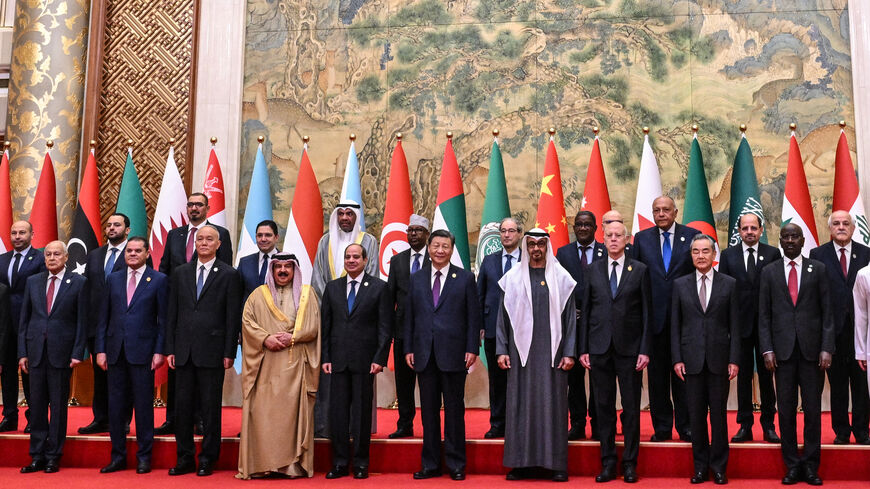
The China-Arab States Cooperation Forum was held on Thursday, May 30, in Beijing. This was the 10th summit of the dialogue platform established in 2004, with the first meeting held in Cairo, Egypt. The forum brought together state leaders and foreign ministers from across the Arab world. At the end of the negotiations, the “Beijing Declaration” was adopted, a work plan for the period 2024-2026 and a joint statement on the situation in Palestine. China has signed a series of bilateral and multilateral cooperation documents with participating countries and the General Secretariat of the Arab League.
President Xi Jinping said at the opening ceremony that “China is ready to work with the Arab side to implement the ‘five frameworks of cooperation’ to step up the construction of a Sino-Arab community with a common future.” The Chinese president also said that the war in Gaza should not continue indefinitely and reaffirmed China’s position to promote a lasting settlement of the Palestinian issue.
The Beijing Declaration reviews the consensus and progress made in implementing the decisions taken at the first China-Arab Summit and charts the way for building a Sino-Arab community with a shared future. The document reaffirms that the PRC and the Arab states will continue to support each other in terms of core interests, deepen pragmatic cooperation and put forward their common positions on the political settlement of regional issues, promote dialogue between civilizations, global governance, combat terrorism, ensuring human rights, will cooperate in the field of climate change, etc.
The work plan outlines the steps for holding multilateral meetings for the next two years and promoting bilateral and multilateral cooperation in areas such as politics, economics and trade, investment, finance, infrastructure, resources and the environment, cultural exchanges, aerospace industry and research, education and the health.
The joint statement on Palestine expresses the concern of China and Arab states over the protracted conflict in Gaza, which has led to a humanitarian crisis. The document outlines the firm position and consensus of the two sides in promoting a ceasefire, providing humanitarian aid, rejecting the forced transfer of the Palestinian people and supporting Palestine’s full membership in the United Nations.
Xi said that the Middle East is a region with broad development prospects, but “war still wreaks havoc. Since October last year, the Palestinian-Israeli conflict has escalated dramatically, bringing enormous suffering to the people.”
President Xi said that Sino-Arab relations have continued to grow to new heights since the beginning of this century. At the previous China-Arab Summit in Riyadh, Saudi Arabia in December 2022, he and fellow Arabs unanimously agreed to build a Sino-Arab community with a shared future in the new era. “China is satisfied with the progress made and will work with the Arab side to enhance the role of the summit in adopting strategic directions for the continued growth of China-Arab relations,” Xi Jinping said.
The summit is called “ministerial” because the states were mainly represented by foreign ministers, but there were also state leaders such as the King of Bahrain, Hamad bin Isa Al Khalifa, the president of Egypt Abdel Fattah al-Sisi, the president of the United Arab Emirates Sheikh Mohamed bin Zayed Al Nahyan, Tunisian President Kais Saied and of course President Xi Jinping. Mohammed bin Salman, Crown Prince and Prime Minister of Saudi Arabia was not present. However, the country was represented by Foreign Minister Faisal bin Farhan Al Saud. In total, officials from 22 Arab states and the Secretary General of the League of Arab States were present.
The five cooperation frameworks are: for investment and financial cooperation; for energy cooperation; for mutually beneficial economic and trade links and interpersonal exchanges.
In terms of innovation, China will build 10 joint laboratories in Arab countries in fields such as health, artificial intelligence, ecological and low-carbon development, modern agriculture and information technology. China is ready to build, together with the Arab side, a joint space debris observation center and a Beidou application, cooperation and development center. Cooperation on manned space missions and passenger aircraft is also being considered.
Egypt, the Emirates and all Arab countries agreed to President Xi Jinping’s Global Security Initiative and called for its adoption on a global scale.