
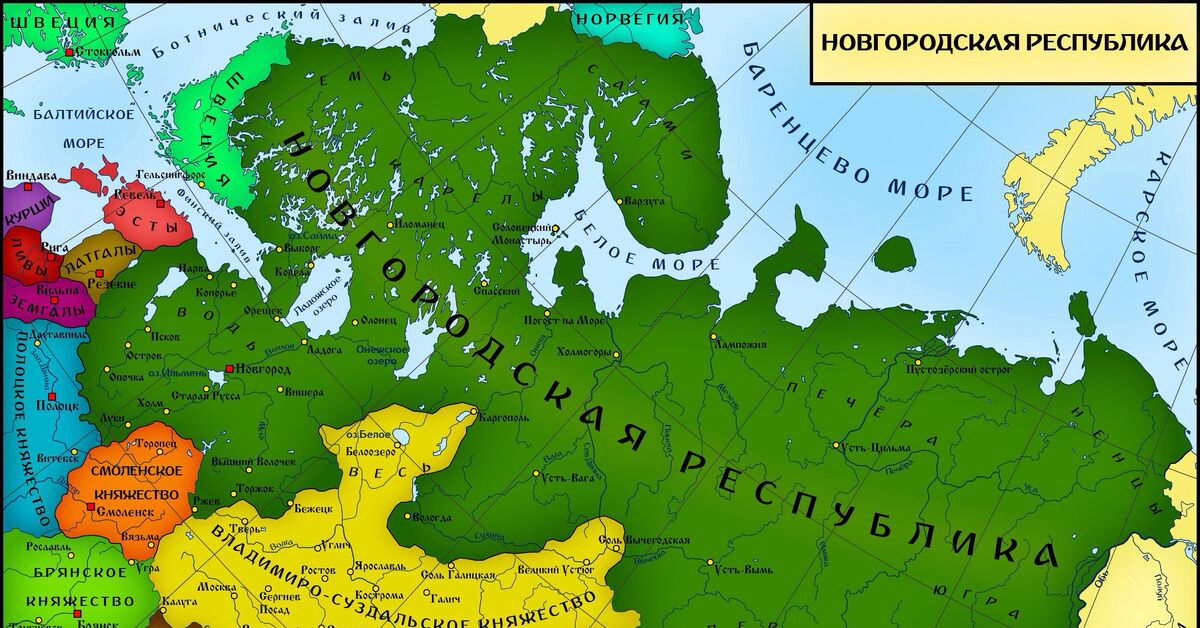
The medieval republic of Novgorod (Russian: Новгородская республика), founded c. 859–862 according to tradition, was the cradle of the Rurikid dynasty and the first capital of Rus’ before Oleg moved the seat of power to Kiev in 882. Throughout the eleventh century, as Kievan Rus’ fragmented under competing princely claims, Novgorod steadily asserted its autonomy. The decisive break came in 1136, when the Veche deposed Prince Vsevolod Mstislavich after his disastrous campaign against Suzdal. From that date onward, Novgorod functioned as a de facto republic, though it continued to invite princes from the Rurikid line to serve as military commanders — figures whose authority was strictly circumscribed by contract. A prince who violated the terms of his appointment could be, and often was, expelled.
The Veche was the supreme organ of state. Open to all free male citizens who owned property, it convened at the sound of a great bell and decided matters of war and peace, taxation, legislation, and the election or dismissal of officials. In practice, real power rested with the boyar aristocracy and the wealthy merchant class (zhitye lyudi), who dominated the Council of Lords (Sovet gospod) and effectively controlled the agenda of the Veche. The chief executive was the Posadnik (mayor), elected annually, assisted by the Tysyatsky (thousand-man commander), who led the urban militia and adjudicated commercial disputes. From 1156, the Veche also elected the city’s own Archbishop, a privilege of enormous political significance that freed Novgorod’s church from Kievan jurisdiction.
The republic’s territory was divided into five administrative districts (kontsy): Vodskaya, Obonezhskaya, Shelonskaya, Derevskaya, and Bezhetskaya. Each outer district paid taxes to its corresponding urban district and could only sell goods to merchants of that district — a system of commercial control that underpinned Novgorod’s wealth but also bred resentment among subordinate towns like Pskov, which gradually won greater autonomy.
Economy and Trade
Novgorod’s power derived from commerce. Sitting astride the “Route from the Varangians to the Greeks”, the city monopolized trade between Rus’ and Western Europe. Its exports — furs, honey, beeswax, hemp, and flax — flowed west via the Volkhov River to the Baltic, while imports of metal goods, wine, cloth, salt, and precious stones arrived from the Hanseatic League and Scandinavia. At its zenith in the thirteenth and fourteenth centuries, Novgorod hosted a permanent Hanseatic trading post (Peterhof), and Western contemporaries called it “the Sun that never sets in the East” (sol oriens numquam occidens).
The republic’s chronic weakness was food security. The northern soil was poor and forest-covered, making agriculture marginal. Novgorod depended on grain imports from Vladimir, Moscow, and Tver — a dependency that Moscow would later exploit as a lever of political control.
Society was stratified into four classes: boyars (hereditary landowners who monopolized urban offices), zhitye lyudi (wealthy merchant-traders), chernye lyudi (commoners — artisans, small traders, and laborers who formed the urban majority), and slaves (kholopy), who could be bought and sold in a dedicated market in the Nerev End district.
The Mongol Shadow and Survival
When Chinghis Khan turned his armies westward in 1219, Novgorod watched with horror as the Khwarezmian Empire — the great Muslim power to the south — collapsed in months. By 1237–1238, Mongol armies had devastated Ryazan, Vladimir, and most of northeastern Rus’. Yet Novgorod was spared. In 1240, Prince Alexander Nevsky — then ruling Novgorod — repelled a Swedish invasion at the Battle of the Neva, and in 1242 he destroyed a Teutonic crusader army on the ice of Lake Peipus (the “Battle on the Ice”), securing the republic’s western frontier. Novgorod subsequently negotiated a tributary relationship with the Golden Horde, paying regular tribute but avoiding direct occupation. This pragmatic submission allowed the republic to preserve its institutions, Orthodox faith, and commercial life — a survival that other Rus’ lands could not claim.
Between 1142 and 1446, Novgorod fought 26 wars with Sweden, 11 with the Livonian Order, 14 with Lithuania, and 5 with Norway — a testament to its restless northern and western frontiers.
Culture and Legacy
Novgorod was a major center of Orthodox Christianity, education, and literacy. The Saint Sophia Cathedral (built 1045–1050) is the oldest stone building in Russia. The city pioneered birch-bark document writing (berestyanye gramoty); Soviet archaeologists recovered over 700 such texts, providing vivid snapshots of everyday life. The republic also produced a distinctive tradition of icon painting and monumental architecture that influenced all of Russian art.
Fall (1471–1478)
By the fifteenth century, Novgorod’s independence was threatened by the rising Grand Duchy of Moscow. In July 1471, at the Battle of the Shelon River, Moscow’s army under Prince Kholmsky annihilated a Novgorodian force of some 20,000, killing 12,000 and capturing 2,000. The republic was forced to accept the Treaty of Korostyn, surrendering vast territories. When Novgorod attempted to ally with Lithuania in 1470 — even contemplating conversion to Catholicism — Ivan III of Moscow used this as a casus belli. In January 1478, Ivan III’s forces entered Novgorod unopposed. The Veche bell was taken to Moscow, the Posadnik office abolished, and the republic’s 340-year independence ended. As Ivan III reportedly declared: “In my lands, including Novgorod, there shall be no Veche bell, no Posadnik — all shall be governed by me alone.”