

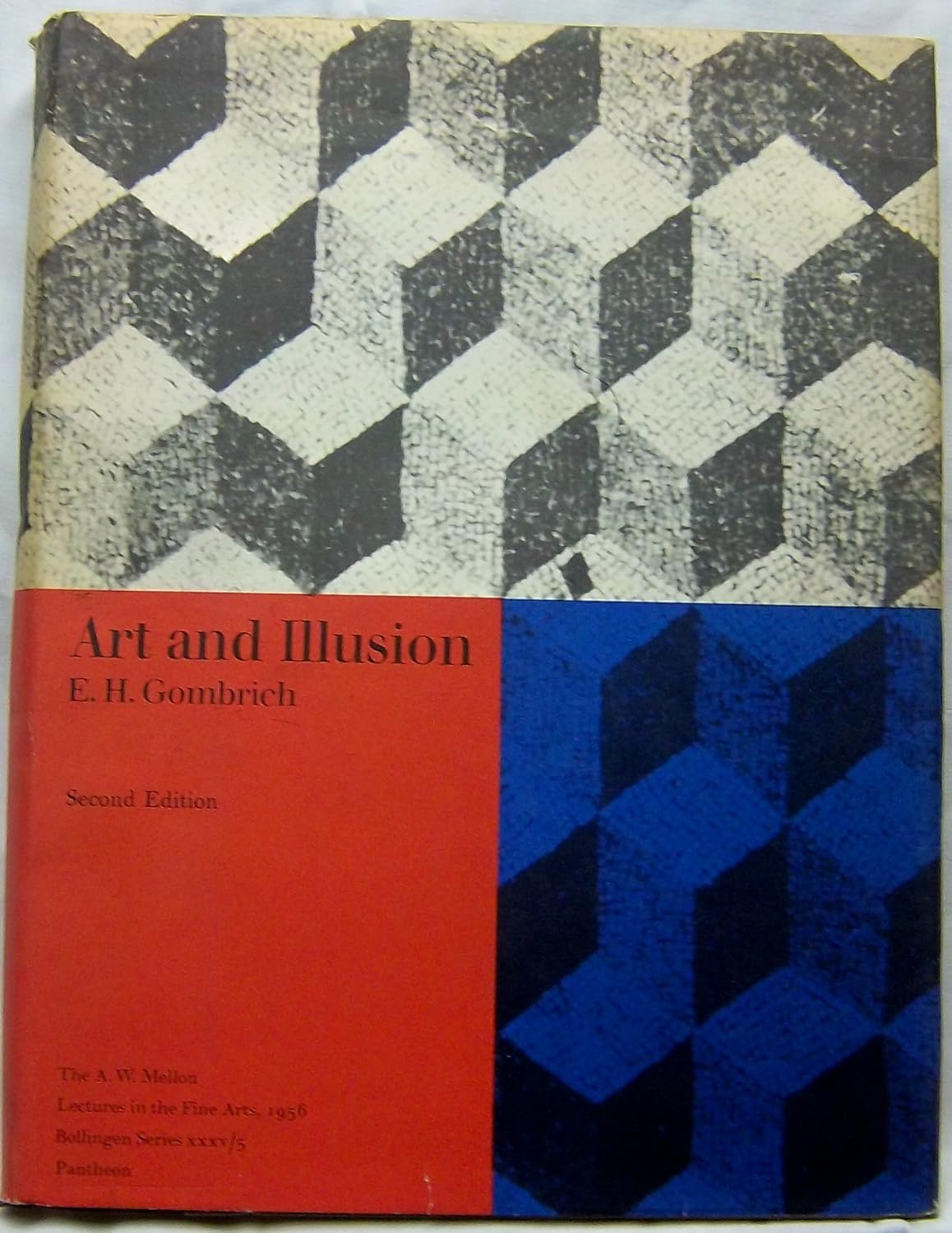
First published in 1960 and based on the A.W. Mellon Lectures in the Fine Arts, Art and Illusion is arguably E.H. Gombrich’s most influential theoretical work. While The Story of Art provided a chronological narrative, this book seeks to answer a deeper psychological question: Why does art have a history? Gombrich explores why it took centuries for humanity to master realistic representation and why different cultures developed such vastly different visual styles.
The book challenges the traditional view that the history of art is a steady progress toward “copying nature.” Gombrich argues that if art were simply about opening one’s eyes and painting what is there, the Greeks or the Egyptians would have achieved photographic realism immediately. Instead, he suggests that the artist’s “eye” is never “innocent.” Every artist is limited by the traditions, techniques, and mental categories they have inherited from their predecessors.
At the heart of the book is the revolutionary concept of “schema and correction.” Gombrich asserts that an artist does not start with a blank slate but with a “schema”—a simplified mental template or shorthand for a figure, a tree, or a building. The artist then compares this schema against reality and makes “corrections” to match what they see. Over generations, these corrections accumulate, leading to the sophisticated realism seen in the Renaissance or the 19th century.
Gombrich also introduces the vital concept of the “beholder’s share.” He argues that a painting is not a complete record of reality but a set of clues that the viewer must interpret. Perception is an active process; the viewer “completes” the image using their own expectations and knowledge. For instance, a few brushstrokes in an Impressionist painting are interpreted by the brain as a crowded street because the viewer’s mind is trained to fill in the missing details.
To illustrate the psychological complexity of perception, Gombrich frequently refers to visual ambiguities and illusions. One of his most famous examples is the “duck-rabbit” figure. He uses this to show that while an image can be interpreted in two ways, the human mind cannot experience both interpretations at the exact same moment. This demonstrates that seeing is an act of interpretation—we must “choose” a hypothesis about what we are looking at.
A major target of Gombrich’s critique is the 19th-century notion of the “innocent eye.” Thinkers like John Ruskin believed that an artist could bypass their knowledge and see the world as a pure arrangement of colors and shapes. Gombrich dismisses this as a myth. He argues that we cannot “unlearn” what we know about the world; our knowledge always filters our perception. Without a pre-existing “vocabulary” of forms (the schema), we would not know how to begin representing reality at all.
Gombrich also uses the book to explain the nature of style. He suggests that style is not just a decorative choice but a “filter” that determines what an artist is capable of seeing and recording. A medieval artist and a Renaissance artist looking at the same cathedral would produce different drawings because their “stylistic vocabulary” dictates which details they notice and which they ignore. Style, therefore, is a tool for communication that carries its own set of possibilities and limitations.
The book is notable for its integration of diverse fields, including information theory, Gestalt psychology, and optics. Gombrich was deeply influenced by the psychologist Karl Popper, particularly the idea of “conjectures and refutations.” He applies this scientific method to art: the artist proposes a “conjecture” (the schema) and then tests it against the “refutation” of nature. This multidisciplinary approach helped move art history away from pure connoisseurship and toward a more rigorous, scientific study of the mind.
Despite its academic depth, Art and Illusion is written in the clear, engaging, and witty prose that became Gombrich’s trademark. He avoids the dense, impenetrable jargon typical of much 20th-century art theory. Instead, he uses relatable examples—from advertising and caricatures to Disney cartoons—to make complex psychological points accessible to a general audience. This clarity ensured the book’s popularity far beyond the walls of the university.
In conclusion, Art and Illusion remains a foundational text that bridged the gap between the humanities and the sciences. It fundamentally changed how we think about the relationship between the mind and the image. By showing that art is a complex system of coding and decoding rather than a simple mirror of nature, Gombrich provided a lasting framework for understanding the evolution of visual culture. It continues to be essential reading for anyone interested in why we see what we see.