

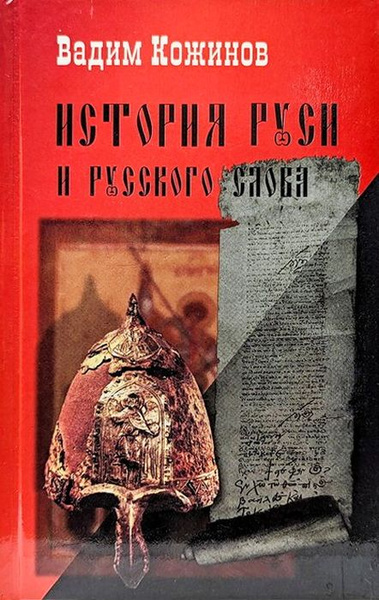
Vadim Kozhinov’s History of Rus and the Russian Word is an intellectual odyssey that treats history as a philological mystery. Kozhinov, primarily known as a literary critic, argues that the Russian state did not just emerge from Viking swords or Byzantine treaties, but from the “Word” (Slovo) itself. For him, the language isn’t merely a tool for communication; it is the structural framework that allowed the East Slavic tribes to coalesce into a unique civilization. This book is a deep dive into the idea that to understand Russian history, one must first understand the Russian language’s metaphysical weight.
The heart of Kozhinov’s analysis lies in the monumental texts of the 11th and 12th centuries, such as Hilarion’s Sermon on Law and Grace and The Lay of Igor’s Campaign. He doesn’t just analyze them as literature; he treats them as “state-building” documents. Kozhinov posits that these works defined the Russian identity as something distinct from both the Roman “Law” and the nomadic chaos of the steppe. By focusing on the concept of “Grace” over “Law,” he builds a compelling—though highly philosophical—case for why Russia developed a political culture so vastly different from Western Europe.
Kozhinov is a staunch “anti-Normanist,” and this book is perhaps one of the most sophisticated defenses of that position. He pushes back against the idea that the Russian state was a foreign import, arguing instead that the linguistic and spiritual readiness of the Slavic people was the true catalyst for statehood. He looks at the 9th-century “Russian Khanate” with a fresh eye, suggesting that the foundations of the empire were laid much earlier and more organically than traditional Western-centric narratives allow.
The prose is dense, demanding, and unapologetically erudite. Kozhinov writes with the confidence of a man who has read every manuscript ever scribbled in a Kievan monastery. He often pauses the historical narrative to engage in long, fascinating linguistic digressions, explaining how specific Slavic roots reflect the social structures of the time. While this can be a hurdle for the casual reader, it is a treasure trove for anyone who believes that history is as much about ideas and symbols as it is about grain yields and troop movements.
One of the more controversial aspects of Kozhinov’s work is his attempt to reconcile the “Russian idea” with its various historical incarnations, including the Soviet period (though this book stays largely in the medieval and early modern eras). He sees a “continuity of the Word” that transcends political systems. His work has a clear “national-patriotic” leaning, but it is supported by a level of scholarship that makes it difficult to dismiss. He isn’t just waving a flag; he is meticulously tracing the threads of a cultural tapestry that has survived Mongol fires and internal collapses.
In summary, History of Rus and the Russian Word is a book for the “thinking” historian. It bridges the gap between the dry facts of Solovyov and the biological theories of Gumilyov, offering a third path: the cultural-linguistic one. It argues that Russia is a “civilization of the Word,” where literature and statehood are inextricably linked. For those who want to understand the deep, almost religious reverence that Russian culture has for its writers and its language, Kozhinov’s work is the definitive guide.