

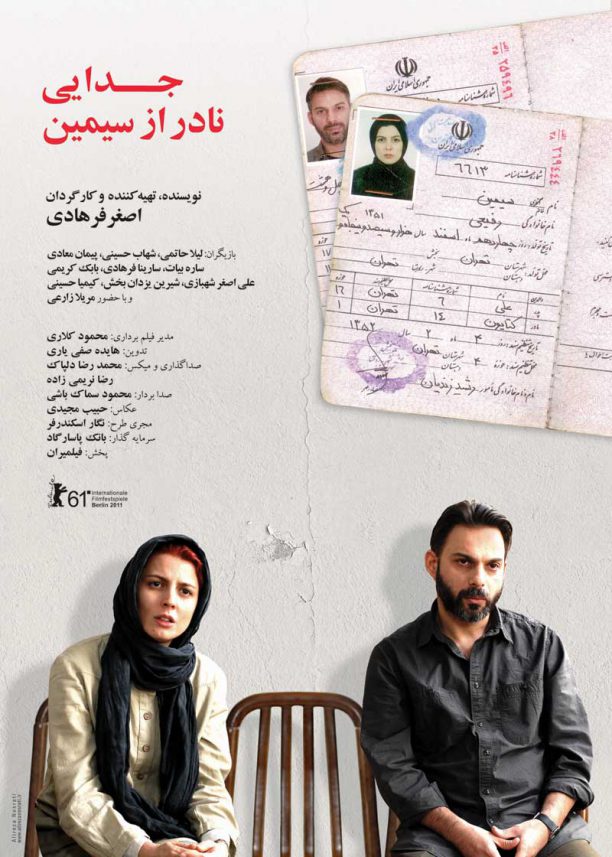
Asghar Farhadi’s A Separation stands as one of the most compelling dramas of the 21st century, a film that transforms a seemingly simple domestic dispute into a profound meditation on truth, class, and the fragility of human relationships. Winner of the Academy Award for Best Foreign Language Film and the Golden Bear at the Berlin International Film Festival, this Iranian masterpiece demonstrates how universal themes can emerge from culturally specific contexts. Farhadi’s screenplay operates with the precision of a thriller while maintaining the emotional authenticity of a family drama, creating a narrative where every revelation deepens rather than resolves the moral ambiguity at its core.
The film centers on Nader and Simin, a middle-class Tehran couple whose separation over whether to emigrate with their daughter Termeh sets in motion a devastating chain of events. When Nader hires Razieh, a deeply religious woman from a working-class background, to care for his Alzheimer’s-stricken father, the resulting conflict exposes the fault lines of Iranian society. Farhadi refuses to assign simple villainy or heroism to any character; instead, he constructs a scenario where every participant acts from understandable, even noble motivations, yet their actions collectively produce tragedy. The director’s use of confined spaces—apartments, courthouses, stairwells—amplifies the sense of entrapment that governs these characters’ lives.
What distinguishes A Separation from conventional courtroom dramas is its unwavering commitment to perspective. The film repeatedly shifts our allegiance, forcing us to reconsider our judgments as new information emerges. The performances, particularly from Peyman Moaadi as Nader and Leila Hatami as Simin, achieve a remarkable naturalism that makes the escalating conflict feel inevitable rather than contrived. Even minor characters, such as Razieh’s volatile husband Hodjat, are rendered with such psychological specificity that they transcend their narrative functions to become fully realized individuals grappling with dignity, shame, and economic desperation.
Farhadi’s direction exhibits extraordinary restraint, employing a documentary-style aesthetic that prioritizes observation over manipulation. The handheld camera work and shallow focus create an intimacy that occasionally feels almost intrusive, as if we are witnessing real arguments between real families. This technique proves particularly effective in scenes involving Termeh, played with heartbreaking maturity by Sarina Farhadi, whose forced position between her parents’ competing narratives mirrors the audience’s own struggle to discern truth from self-justification. The film’s famous final shot—an extended take of Termeh’s face as she must choose between parents—encapsulates Farhadi’s humanist philosophy: in matters of love and justice, there are no clean resolutions, only painful accommodations.
A Separation ultimately transcends its Iranian setting to address universal questions about responsibility, faith, and the limits of empathy. Farhadi demonstrates that the most profound cinema need not rely on spectacle or sentimentality, but rather on the careful observation of how ordinary people navigate impossible choices. The film’s conclusion, which refuses the catharsis of conventional resolution, lingers in the mind long after viewing, challenging audiences to examine their own assumptions about guilt and innocence. In an era of increasingly polarized discourse, A Separation offers a vital reminder of cinema’s capacity to foster understanding across cultural and ideological divides—a masterpiece that earns its accolades through sheer artistic integrity.