

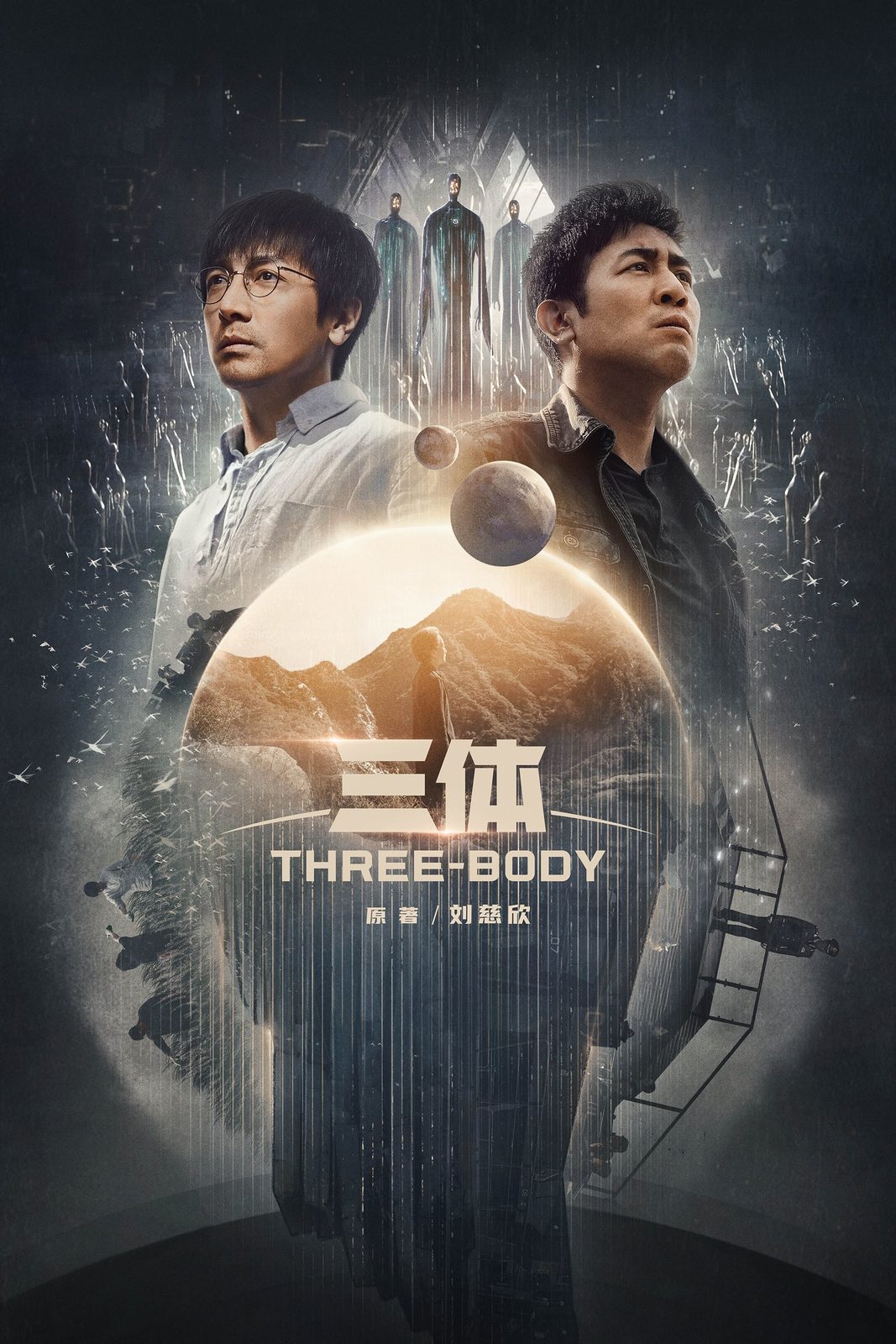
The Chinese TV series directed by Yang Lei and Vincent Yang is based on the novel “Three Body | 三体 | sān tǐ” written by Liu Cixin | 刘慈欣 in 2006. The story is about the establishment of first contact with an extraterrestrial civilization. Unfortunately for humanity, the said civilization, the Trisolarians, want to colonize Earth (newly discovered as a result of the contact) because their home planet is in an unstable solar system. The series was produced by Tencent Video.
In a world where the boundaries between science, fiction and fear are becoming increasingly blurred, “The Three-Body Problem” (adaptation of the famous novel by Liu Cixin) manages to transform an abstract concept – contact with an extraterrestrial civilization – into a tense drama, anchored in the troubled reality of the 21st century.
The action begins in 2007, when Wang Miao, a renowned Chinese expert in nanomaterials, is recruited by detective Shi Qiang – also known as Da Shi – to investigate a wave of suspicious suicides among scientists. What initially seems like an investigation with a touch of police thriller quickly turns into a terrifying discovery: a clandestine organization, called the Frontiers of Science, seems to have infiltrated the academic world and has direct ties to an extraterrestrial civilization called Trisolaris.
The series’s strength is the way it combines elements of real science with the psychological tension of a multi-layered mystery. The virtual reality game Three Body, which Wang Miao immerses himself in as part of the investigation, is not only a fascinating technological experiment, but also a gateway to another world – a simulation of the planet Trisolaris, where the laws of physics seem fluid and cyclical chaos is the norm. Created by the Earth-Trisolaris Organization (ETO), the game becomes a tool for manipulation and recruitment for an alien agenda with devastating implications.
Beyond the suspense of the narrative, “The Three-Body Problem” impresses with the strength of its characters. Wang Miao, played with sobriety by Zhang Luyi, is a rational scientist, but fragile in the face of realities that defy his logic. In contrast, Da Shi, brought to life with charisma by Yu Hewei, is a tough, direct, ironic detective, but with an intuition that makes him essential in deciphering the global plot. Their relationship – an unlikely tandem of rationality and instinct – provides the emotional backbone of the series.
Another memorable character is Ye Wenjie, an astrophysicist scarred by the traumas of the Cultural Revolution, who plays a key role in establishing first contact with Trisolaris. Her story brings a deep historical and moral dimension, exploring the dilemma of betraying the species in the name of disillusionment with humanity.
“The Three-Body Problem” is not just a science fiction series; it is a meditation on the limits of knowledge, the fragility of civilization and how scientific answers can easily become weapons of uncertainty and fear. With impressive production, visual effects that support the narrative tension without overshadowing it, and a script that doesn’t underestimate the intelligence of the audience, this adaptation is a success that will keep you thinking long after the end credits roll.
A captivating exploration of the collision of science and fiction, “The Three-Body Problem” is a series that raises uncomfortable questions about the future of humanity and what “contact” with another life form really means. A remarkable production for sci-fi fans, but also for those looking for a psychological and philosophical thriller at the same time.