

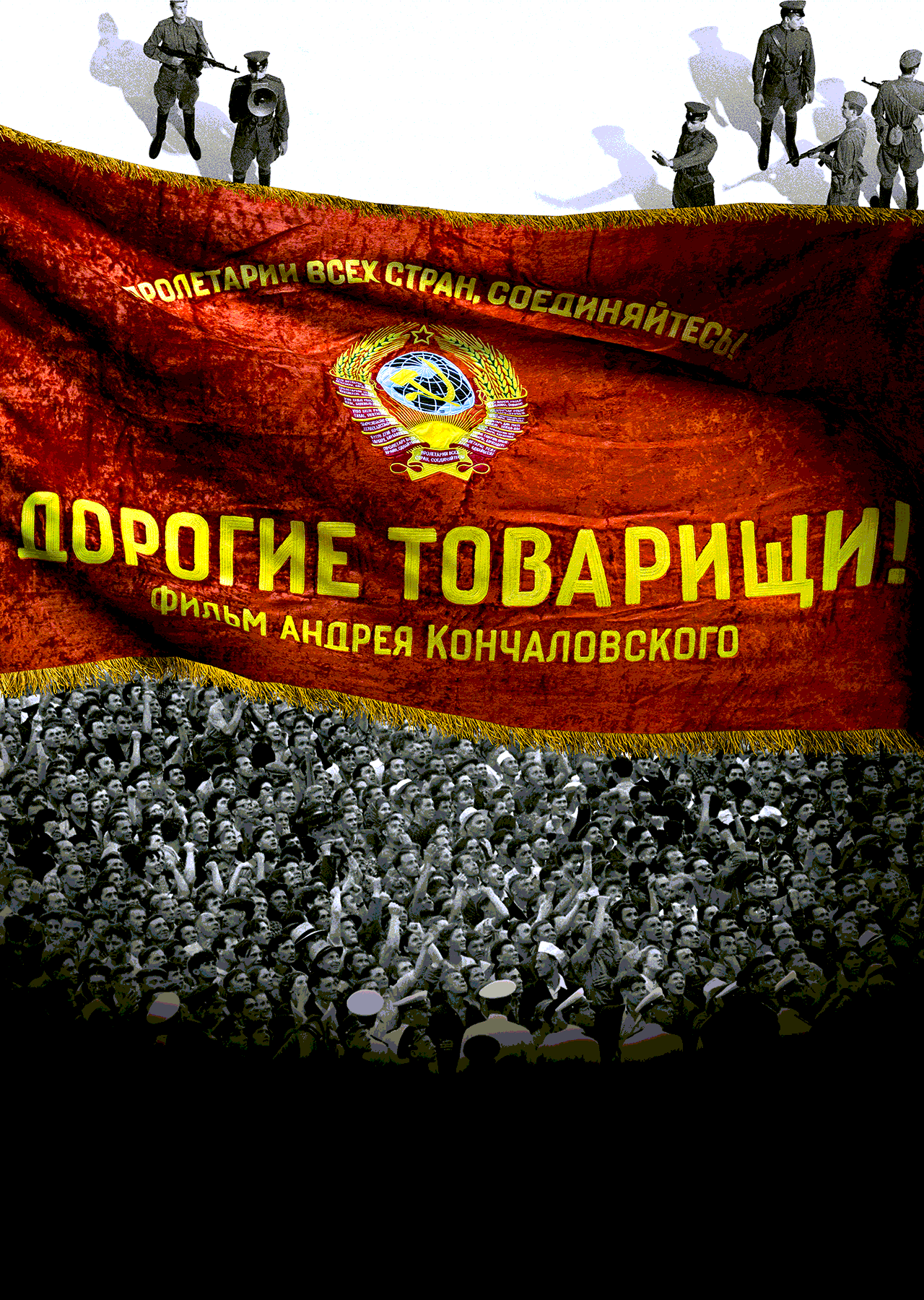
“Дорогие товарищи!” (2020) is a Russian historical drama directed by Andrei Konchalovsky that explores the 1962 Novocherkassk massacre. The film follows the tragic events that occurred when the government raised food prices, provoking a workers’ uprising in the small industrial town. In the dispersal of the demonstrators, 26 people were killed and 87 were injured, events that were kept secret by the Soviet authorities for decades. Konchalovsky builds a shocking story around this dark episode in the history of the USSR, focusing on the human drama and the transformation of a convinced communist in the face of reality.
Yulia Vysotskaya plays the role of Lyuda, a middle-aged district Communist Party official who is having an extramarital affair and leading a privileged life. Konchalovsky takes an unusual approach by presenting the massacre from the perspective of a participant in the power apparatus, not the victims. This narrative choice is ingenious, as it allows us to explore the internal contradictions of the Soviet system through the eyes of someone who sincerely believed in its ideals. Lyuda becomes a character through whom we can understand the complexity of situations in which people dedicated to a cause face seemingly insoluble contradictions and seek means to serve both collective and individual interests.
Yulia Vysotskaya’s remarkable acting is the driving force of the film. The actress manages to create a complex character, who evolves from trusting standard protocols to actively seeking unconventional solutions to an extraordinary situation. Vysotskaya skillfully navigates the character’s psychological transformation, from the rigorous application of administrative procedures to a more flexible and empathetic approach, driven by her sense of responsibility to the community. The expressiveness and subtlety with which she conveys Lyuda’s growing commitment to finding ways to improve the situation make this performance memorable and compelling.
The film is shot in grainy black and white and framed in academy ratio, evoking the look of films from that era and creating a sense of historical authenticity. This aesthetic choice anchors the film in its historical period and contributes to the atmosphere of nostalgia. Konchalovsky’s cinematography uses meditative shots and controlled camera movements to create an atmosphere of reflection and focus on the human dimension of events. The contrasts between black and white emphasize the moral complexity of the situations.
The film contains a series of sequences of remarkable dramatic intensity. The scene of the workers’ revolt and the brutal intervention of the security forces constitutes the climax of the narrative, being realized with crushing realism. The moments in which Liuda gradually realizes the magnitude of the tragedy and her indirect involvement in it are constructed with impressive psychological precision. The sequences of her daughter (played by Yulia Burova) searching among the victims add a dramatic personal dimension, transforming the collective tragedy into an individual trauma.
The character of KGB officer Loginov, played by Vladislav Komarov, brings a nuanced perspective on the Soviet security apparatus. Komarov presents Loginov as a “cynical and skillful” officer who proves to be an unexpected ally for Liuda in her search for her daughter. Although initially reluctant, he offers empathetic help to the protagonist, demonstrating human solidarity.
The relationship between Liuda and the KGB officer develops “a certain romantic chemistry”, which adds a complex personal dimension to their professional interaction. Through this character, Konchalovsky suggests that the system is not monolithic and that individuals within the state apparatus can act out of personal motivations and empathy, offering help in times of crisis when official protocols prove insufficient or inadequate. Loghinov thus becomes an example of how interpersonal relationships can transcend institutional barriers, demonstrating that humanity can persist even in highly formalized and hierarchical contexts.
The film’s soundtrack is used sparingly, the director preferring to let the tension build organically from situations and dialogues. When music appears, it emphasizes moments of maximum emotional intensity without becoming invasive. Ambient sounds – the murmur of crowds, the rumble of industrial machinery, the eerie silence that follows gunshots – are used to create a realistic sound texture that amplifies the visual impact. This minimalist approach to sound contributes to the authenticity and emotional impact of the film.
The film explores a complex chapter in Soviet history through the story of a devoted communist who tries to find ways to serve both the system and the people. Lyuda’s psychological transformation forms the moral core of the film, representing the evolution from a formal approach to an active personal involvement in the search for solutions. The director subtly explores the process by which a person can expand their understanding of social responsibility.
The film can be interpreted as a meditation on the nature of individual responsibility and the moral choices we make within any political system. The themes addressed – civic engagement, conflict mediation, personal responsibility towards the community but also propaganda, suppression of dissent, individual responsibility in the face of oppression – transcend the specific historical context and remain extremely relevant in any contemporary society. Konchealovsky explores how individuals confront universal ethical dilemmas: how do you balance loyalty to institutions with moral duty to your fellow human beings? How do you respond when standard protocols and orders from superiors conflict with human imperatives?
It offers insight into how people can navigate complex social challenges by taking personal responsibility and seeking solutions that put human dignity first. Regardless of the political system – Soviet, capitalist, democratic or authoritarian – individuals face the same fundamental questions of courage, morality and ethical responsibility.
“Dear Comrades!” serves as an exploration of how individual character and moral integrity can make a difference in critical moments, demonstrating that the true measure of a person lies in the choices they make when confronted with human suffering and concrete injustices. In other words, any system is only as good as the people who keep it going.
The film also functions as a critical analysis of the systemic dysfunctions that can arise in any rigid power structure, using the Soviet context as a case study for the broader problems of authoritarianism. The events in Novocherkassk are chosen to illustrate how systems that promise equality and well-being can resort to violence when those who issue the orders are not up to the task, revealing a fundamental contradiction between ideals and practice.
The personal approach, centered on the character of Lyuda, brings the action into a more personal context in which her internal transformation becomes the central element – a gradual disillusionment that symbolizes the awakening to the unfulfilled promises of the system, thus foreshadowing the inevitable reformation or dismantling of a system that has lost its credibility.
Contradictions abound and are presented as symptoms of a deeper crisis: Lyuda’s father, nostalgic for the time of the Tsars, hides his religious faith, while her daughter was so confident in communist ideals that she came close to dying on party orders for party slogans. These paradoxes illustrate not only hypocrisy but also how the system has created fragmented personalities, forcing people to live in constant contradiction.