

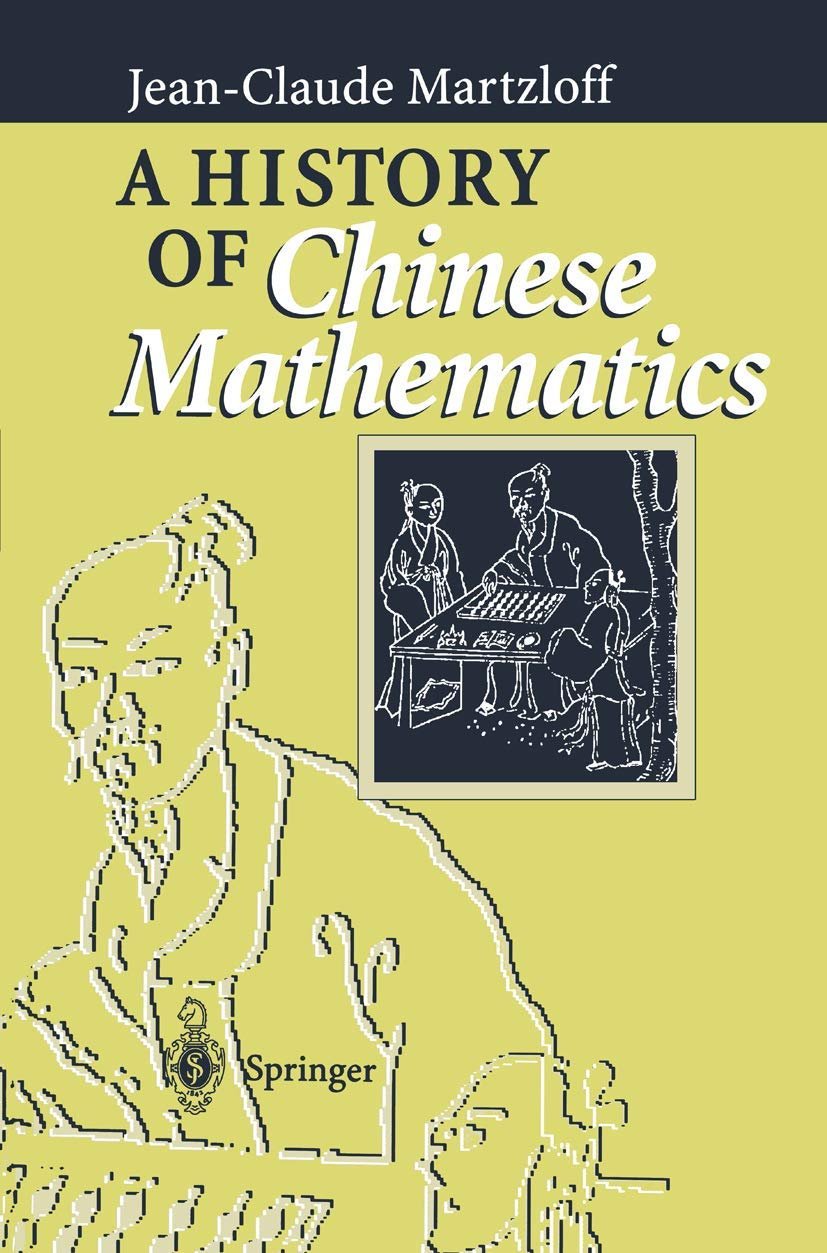
Jean-Claude Martzloff’s Histoire des mathématiques chinoises is a monumental work that bridges the gap between Eastern and Western mathematical traditions, offering readers a meticulously researched and engaging exploration of China’s rich contributions to the field. Martzloff, a renowned historian of mathematics, brings his expertise to bear in this comprehensive volume, tracing the evolution of Chinese mathematics from antiquity to the early modern period while challenging Eurocentric narratives that have long dominated the discipline.
Structure and Scope
The book is organized chronologically, beginning with the earliest mathematical artifacts, such as oracle bones and bamboo slips, and progressing through key dynasties like the Han, Tang, Song, and Ming. Martzloff does not merely list achievements but situates them within their cultural, political, and technological contexts, revealing how mathematics was intertwined with astronomy, administration, and engineering. For instance, he delves into the Nine Chapters on the Mathematical Art (Jiuzhang Suanshu), a foundational text, and explains its practical applications in land measurement, taxation, and architecture. His analysis of later works, such as the Mathematical Treatise in Nine Sections (Shushu Jiuzhang) by Qin Jiushao, highlights China’s advancements in algebra and number theory, often centuries ahead of Western counterparts.
Methodology and Insights
Martzloff’s approach is both scholarly and accessible. He avoids overly technical jargon, making the book suitable for both specialists and general readers interested in the history of science. His use of primary sources, including translated excerpts from original texts, adds authenticity, while his comparisons with Greek, Indian, and Islamic mathematics underscore the interconnectedness of global intellectual history. One standout feature is his discussion of the transmission of knowledge along the Silk Road and via Jesuit missionaries, illustrating how Chinese mathematics both influenced and was influenced by other traditions.
Themes and Contributions
A central theme is the pragmatic nature of Chinese mathematics, driven by real-world problems rather than abstract theorization. Martzloff argues that this focus on utility—whether in calendar-making, surveying, or commerce—fostered innovations like the decimal system, negative numbers, and early forms of calculus. He also addresses misconceptions, such as the myth that China lacked a tradition of mathematical proof, by showcasing rigorous methods employed in texts like The Sea Island Mathematical Manual.
Cultural Context and Legacy
The book excels in portraying mathematics as a dynamic part of Chinese civilization. Martzloff explores how Confucian ideals, imperial patronage, and social structures shaped mathematical practice. For example, he explains how the imperial examination system promoted mathematical literacy among scholars, even as it sometimes stifled creativity. His final chapters examine the decline of traditional mathematics under Qing dynasty conservatism and its revival in the 20th century, providing a nuanced perspective on China’s modern scientific resurgence.
Criticisms and Considerations
While the book is thorough, its density may overwhelm casual readers. Some sections, particularly those involving complex calculations or historical debates, require careful attention. Additionally, the focus on pre-modern mathematics means that 20th-century developments are only briefly touched upon, leaving readers curious about China’s role in contemporary mathematics.