

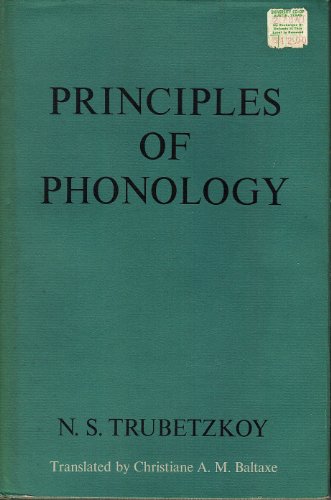
Nikolai Trubetzkoy’s Principles of Phonology (published posthumously in 1939) stands as one of the most significant pillars of the Prague School of linguistics. While Saussure provided the broad structural blueprint for language, Trubetzkoy focused his lens specifically on the sound system. He argued that phonology should be treated as distinct from phonetics; while phonetics deals with the physical production of sounds, phonology investigates the functional role those sounds play within a specific linguistic system.
At the heart of Trubetzkoy’s work is the concept of the phoneme, which he redefined not just as a sound, but as a bundle of distinctive features. He demonstrated that a sound’s identity is defined by its “oppositions” to other sounds. For example, the difference between /p/ and /b/ in English is a “voicing” opposition. This methodology allowed for a rigorous, mathematical-like classification of sound systems, proving that every language organizes its acoustic space according to a strict internal logic.
Trubetzkoy also introduced the crucial concept of neutralization. He observed that in certain positions, the distinction between two phonemes can disappear. A classic example is found in German, where the distinction between /d/ and /t/ is lost at the end of a word (both are pronounced as [t]). This discovery was revolutionary because it showed that linguistic rules are context-dependent and that the “value” of a linguistic unit changes based on its environment within the structure.
The book is also notable for its global scope. Trubetzkoy didn’t just analyze European languages; he drew data from hundreds of diverse languages to create a typology of sound systems. His work moved linguistics toward a more universalist perspective, seeking the underlying principles that govern human speech across all cultures. This paved the way for the later development of “generative” phonology and influenced giants of the field like Roman Jakobson.
Though Principles of Phonology is a technical and demanding text, its impact on the structuralist movement is immeasurable. It transformed the study of speech from a branch of physiology into a sophisticated branch of semiotics. For any student of language, Trubetzkoy’s work remains the definitive guide to understanding how raw sound is converted into meaningful human communication through the power of systemic contrast.